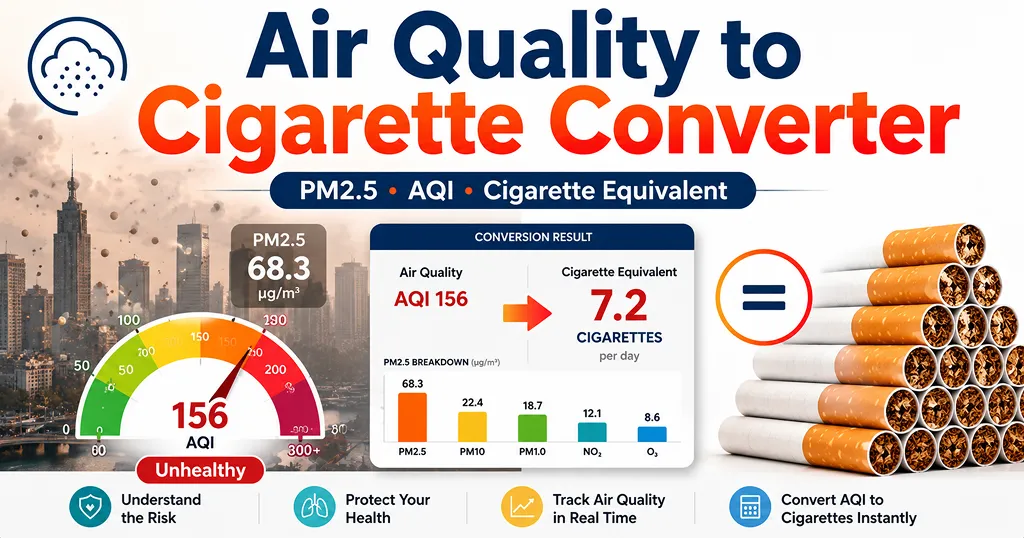
Convert PM2.5 air pollution or U.S. AQI into a rough cigarette-equivalent exposure. Enter a fine-particle concentration, or enter AQI and let the calculator estimate PM2.5 using EPA PM2.5 breakpoints.
This calculator uses the rough public-health comparison: 22 µg/m³ of PM2.5 for 24 hours is approximately equivalent to one cigarette. It is a communication tool, not a medical diagnosis.
- This calculator uses a simplified cigarette-equivalent rule of thumb: 22 µg/m³ PM2.5 for 24 hours ≈ one cigarette.
- AQI conversion is based on U.S. EPA PM2.5 24-hour AQI breakpoints. AQI systems can differ by country, and AQI can be driven by pollutants other than PM2.5.
- The WHO PM2.5 annual guideline value used for comparison is 5 µg/m³. The comparison is informational and does not define a personal safe threshold.
- During wildfire smoke, dust storms, or hazardous AQI conditions, follow local public-health alerts and emergency guidance.
- Sources: Berkeley Earth, U.S. EPA AQI Breakpoints, AirNow AQI Basics, WHO Global Air Quality Guidelines.
Air Quality to Cigarette Converter
The Air Quality to Cigarette Converter helps translate fine-particle air pollution into a more intuitive cigarette-equivalent number. Air quality data is often shown as PM2.5or AQI, but many people find it hard to understand what those numbers mean in daily life. This calculator turns PM2.5 exposure into a rough “how many cigarettes is this like?” estimate.
The calculator is especially useful during wildfire smoke, heavy smog, dust events, travel planning, outdoor sports, commuting, and indoor air purifier comparisons. Instead of only seeing “AQI 150” or “PM2.5 55 µg/m³,” you can estimate the equivalent exposure for one day, one week, one month, or one year.
Formula used by this calculator
This page uses the public rule of thumb popularized by Berkeley Earth:
Cigarette equivalent = PM2.5 ÷ 22 × exposure hours ÷ 24 × exposure days
In other words, an average PM2.5 concentration of 22 µg/m³ for 24 hours is treated as roughly equivalent to one cigarette. This is not saying that air pollution and smoking are chemically identical. Cigarette smoke and outdoor PM2.5 have different sources and particle mixtures. The conversion is a simplified risk-communication tool that makes invisible fine-particle exposure easier to understand.
PM2.5 vs AQI: what is the difference?
PM2.5 is a concentration measurement. It describes fine particulate matter with a diameter of 2.5 micrometers or smaller, usually shown in µg/m³. These particles are small enough to penetrate deep into the lungs and are one of the main pollutants used in air-quality health guidance.
AQI, or Air Quality Index, is a public communication scale. The U.S. AQI turns pollutant concentrations into categories such as Good, Moderate, Unhealthy for Sensitive Groups, Unhealthy, Very Unhealthy, and Hazardous. When you enter AQI in this calculator, it estimates the corresponding 24-hour PM2.5 concentration using the U.S. EPA PM2.5 AQI breakpoint table.
How to use the cigarette-equivalent result
A result such as 2 cigarettes per day does not mean you literally smoked two cigarettes. It means the selected PM2.5 exposure is roughly comparable, in this simplified model, to the long-term health-impact scale of that number of cigarettes. The result is most useful for comparing scenarios: outdoor air vs filtered indoor air, a short commute vs a full day outside, or today’s smoke level vs a cleaner day.
For example, if outdoor PM2.5 is 88 µg/m³ and you are exposed for 24 hours, the calculator estimates about four cigarette-equivalents for that day. If you use indoor filtration and reduce exposure by 50%, the effective PM2.5 becomes 44 µg/m³, and the estimated cigarette-equivalent exposure is cut in half.
What makes this converter different?
- PM2.5 and AQI input modes: enter either raw PM2.5 concentration or U.S. AQI.
- Exposure-time adjustment: calculate a short outdoor workout, a commute, a full day, or a multi-day smoke event.
- Filter and mask reduction: estimate how much exposure could be avoided with indoor filtration, better ventilation control, or a respirator-style mask.
- Weekly, monthly, and yearly projection: see how repeated “moderate” exposure can accumulate over time.
- WHO guideline comparison: compare the result with the WHO annual PM2.5 guideline level of 5 µg/m³.
FAQ
- Q. Is breathing polluted air exactly the same as smoking?A. No. The sources, chemistry, dose pattern, and personal risk factors are different. The cigarette number is a simplified comparison designed to make PM2.5 exposure easier to understand.
- Q.Why does the calculator focus on PM2.5?A. PM2.5 is one of the most widely monitored pollutants and is strongly associated with air-quality health guidance. AQI may also reflect ozone, PM10, carbon monoxide, sulfur dioxide, or nitrogen dioxide depending on location and pollutant levels.
- Q. Can I use AQI instead of PM2.5?A. Yes. Choose the AQI input mode. The calculator will estimate PM2.5 using the U.S. EPA 24-hour PM2.5 breakpoint table. This is most appropriate when the AQI you are using is driven by PM2.5.
- Q. What should I enter for filter or mask reduction?A. Use 0% if you are not sure. If you have a trusted indoor sensor, you can estimate reduction by comparing outdoor PM2.5 with indoor PM2.5. For example, outdoor 80 and indoor 40 is about a 50% reduction.
- Q. Is this a medical tool?A. No. This calculator is for education and risk communication. People with asthma, heart disease, lung disease, pregnancy, children, and older adults should follow local public-health guidance.