What is BAC?
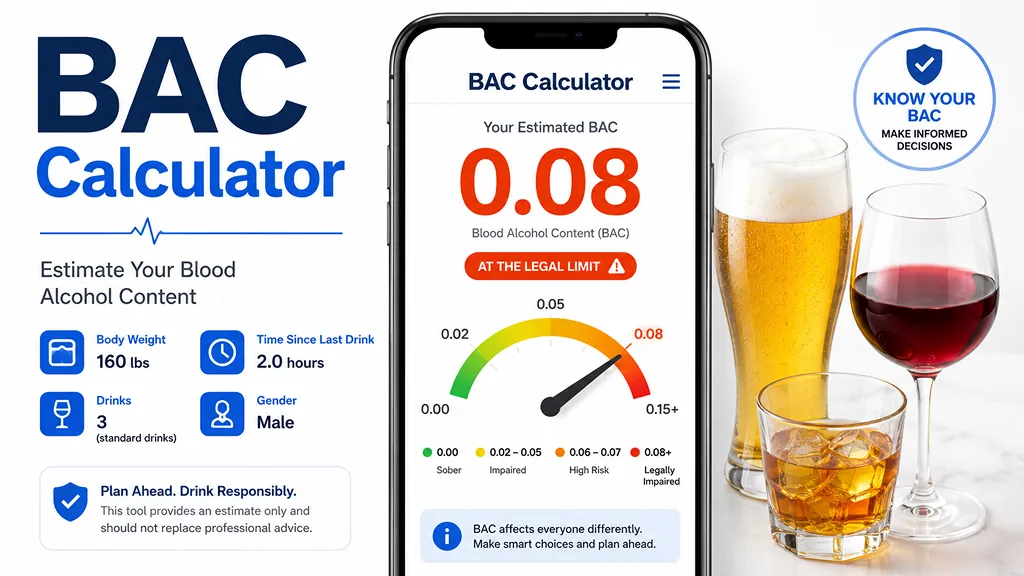
BAC stands for blood alcohol concentration or blood alcohol content. It estimates how much alcohol is present in the bloodstream. In the United States, BAC is commonly written as a percentage, such as 0.08%. A BAC of 0.08 means there are about 0.08 grams of alcohol per 100 mL of blood.
This BAC calculator estimates BAC from body weight, a Widmark-style body water factor, drink size, alcohol by volume (ABV), number of servings, and time since the first drink. The result is useful for understanding how alcohol amount, drink strength, and time can affect an estimated BAC, but it is not a legal, medical, or breath-test result.
How this BAC calculator works
This calculator first converts every drink into pure alcohol. It then estimates BAC using a Widmark-style equation and subtracts an estimated hourly alcohol elimination rate.
BAC = (A × 5.14 / (W × r)) - (metabolism rate × hours)
In this formula,
A is fluid ounces of pure alcohol, W is body weight in pounds, and r is the body water factor. The calculator defaults to 0.73 for the male estimate and 0.66 for the female estimate, but you can enter a custom factor if you want to compare another assumption.What counts as one standard drink in the U.S.?
In the United States, one standard drink contains about 0.6 fluid ounces or about 14 grams of pure alcohol. That is roughly equivalent to:
- 12 fl oz of regular beer at 5% ABV
- 5 fl oz of wine at 12% ABV
- 1.5 fl oz of distilled spirits at 40% ABV
The number of glasses is not always the same as the number of standard drinks. A 16 oz craft beer, a large wine pour, a strong cocktail, or a high-proof liquor serving may contain more than one standard drink. That is why this calculator lets you adjust drink type, amount, serving size, unit, and ABV.
Why the graph starts at the first drink
The result graph starts at the time of the first drink, marks the current estimate as Now, and continues forward until the estimate approaches zero. This makes it easier to understand the full timeline instead of only seeing a countdown from the current moment.
The graph uses simple labels such as Start, Now, and +3 hr 40 min. For more exact timing, hover over a point on the graph. The tooltip shows the estimated BAC and the approximate local clock time for that point.
The graph uses the same simplified Widmark-style estimate as the calculator. It does not model the full alcohol absorption curve. In real life, BAC may continue rising after the last drink, especially if alcohol was consumed quickly or with food.
BAC thresholds shown in the result
The calculator shows estimated time to fall below 0.08, 0.05, 0.04, and near 0.000. These reference points are useful because different situations may use different BAC thresholds.
In most U.S. states, 0.08 is the common adult non-commercial driving limit. Utah uses 0.05. Commercial drivers, drivers under 21, probationary drivers, workplace rules, and zero-tolerance situations may involve lower thresholds. A BAC estimate below a legal threshold does not mean a person is safe to drive.
Effects by estimated BAC range
Alcohol affects people differently. Body size, drinking speed, food, medication, fatigue, tolerance, and health conditions can change how impaired someone feels at the same BAC. The table below is a general educational guide, not a diagnosis or safety clearance.
Why BAC calculators can be wrong
A BAC calculator is helpful for education and scenario comparison, but it cannot know your exact BAC. Real BAC can differ because of:
- how quickly alcohol was consumed
- whether you ate before or while drinking
- body composition and hydration
- medications, sleep, illness, or health conditions
- drink size, pour size, and ABV accuracy
- whether alcohol is still being absorbed
Can coffee, food, water, or a shower lower BAC faster?
Coffee, food, water, sleep, or a shower may change how alert someone feels, but they do not reliably make alcohol leave the bloodstream faster. Time is the main factor after alcohol is absorbed. Food can slow absorption if eaten before or while drinking, but it does not instantly remove alcohol already in the body.
How to use this BAC calculator
- Enter body weight and choose pounds or kilograms.
- Choose the body water estimate used for the Widmark calculation.
- Add beer, wine, liquor, cocktail, or other drinks.
- Enter the amount, serving size, unit, and ABV for each drink.
- Enter the hours and minutes since the first drink.
- Review the estimated BAC, standard drinks, graph, drink breakdown, and countdown table.
Frequently asked questions
- Q. Is this BAC calculator legally accurate?A. No. This calculator is only an estimate. Legal BAC can only be determined through approved testing methods and law enforcement procedures.
- Q. Why does the calculator use time since the first drink?A. BAC changes over time as alcohol is absorbed and metabolized. Time since the first drink gives a simple way to estimate how much alcohol may have been processed.
- Q. Why do craft beer and cocktails change the result so much?A. BAC depends on pure alcohol, not just the number of glasses. A strong beer, large wine pour, or cocktail can contain more than one standard drink.
- Q. Does a lower BAC mean I can drive?A. No. Impairment can begin below common legal limits, and rules can vary by state, age, driver type, workplace policy, and situation.
Important safety note
This BAC calculator should not be used to decide whether you can drive. If you have been drinking, use a rideshare, taxi, public transportation, designated driver, or stay where you are. A calculator result cannot protect you from impairment, crashes, arrest, injury, or legal consequences.