What is a birth chart?
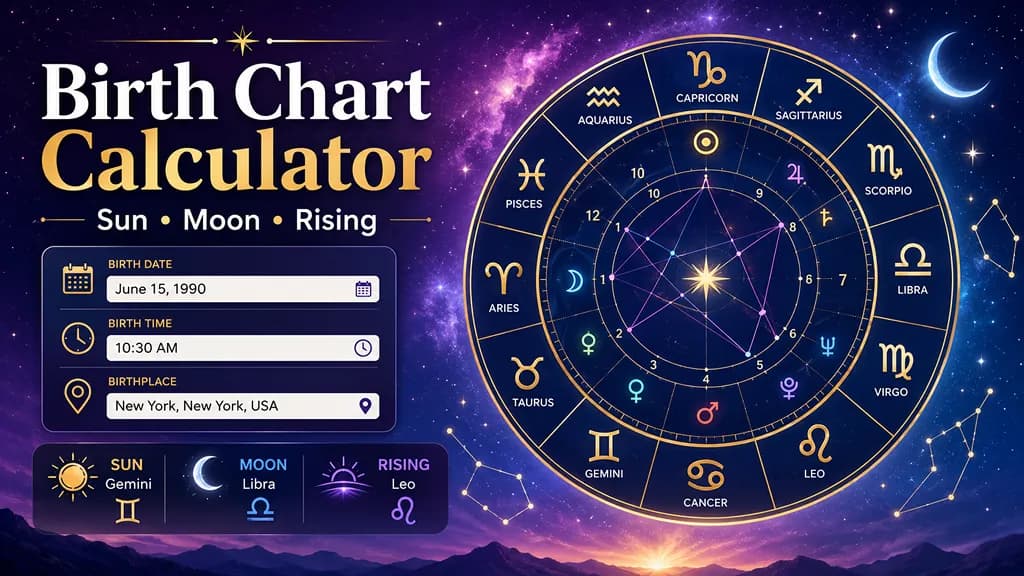
A birth chart, also called a natal chart, is an astrology chart based on the date, time, and place of birth. It shows where the Sun, Moon, and other chart points are placed around the zodiac wheel at the moment of birth. Many people use a birth chart calculator to find their Sun sign, Moon sign, Rising sign, moon phase, and house placements.
In Western astrology, a birth chart is usually read as a symbolic map for personality, emotional patterns, first impressions, relationships, career direction, and life themes. This calculator uses the Western tropical zodiac and focuses on the most commonly searched beginner placements: Sun, Moon, Rising, Midheaven, moon phase, Big Three balance, and equal-house cusps.
What is a birth chart calculator?
A birth chart calculator estimates the zodiac positions for your birth data. Instead of looking up each placement manually, you enter your birth date, local birth time, and birthplace, and the calculator converts that information into an estimated astrology chart.
This tool is designed for quick chart exploration without creating an account, entering an email address, or saving a public profile. You can enter an initial or nickname if you want to label the result, but a full legal name is not needed.
What information do you need?
- Birth date: the calendar date you were born.
- Birth time: the time printed on a birth certificate is best.
- Birthplace: the city or coordinates where you were born.
- Time zone: the calculator converts local birth time to UTC automatically.
Enter the birth time as local time. You do not need to manually adjust for daylight saving time. The selected time zone is used to convert the local birth time into UTC before calculating the chart.
What if you do not know your birth time?
If your birth time is unknown, this calculator can still estimate your Sun sign, Moon sign, and moon phase using noon as a placeholder. However, it will not show the Rising sign, Midheaven, Descendant, IC, or house cusps because those chart points depend strongly on the exact birth time.
The Moon can change signs during a day, so unknown birth time results include a daily range table. If the Moon is in the same sign at both 00:01 and 23:59 local time, the Moon sign is more likely to be stable for that date. If the table shows two different signs, an exact birth time is needed to know the correct Moon sign.
Why the Rising sign is time-sensitive
The Rising sign, also called the Ascendant, is the zodiac degree rising near the eastern horizon at the moment of birth. Because Earth rotates continuously, the Ascendant changes much faster than the Sun sign. A birth time difference of 15, 30, or 60 minutes can sometimes move the Rising sign to another sign, especially near sign boundaries.
For this reason, the result includes a Rising sign time sensitivity table. It shows how the Ascendant changes when the birth time is shifted by 15 and 30 minutes. This is useful when you know your approximate birth time but are not completely sure of the exact minute.
Sun sign, Moon sign, and Rising sign meaning
- Sun sign: often read as core identity, vitality, ego, and life direction.
- Moon sign: often read as emotional needs, instincts, memories, and private inner life.
- Rising sign: often read as first impression, body language, personal style, and the starting point of the house system.
What are astrology houses?
Astrology houses divide the chart into twelve sections. Each house is commonly associated with a different area of life, such as self-image, money, communication, home, creativity, work routines, partnerships, shared resources, travel, career, community, and rest.
This calculator uses a simple equal-house estimate, where the 1st house begins at the Ascendant and each house covers 30 degrees. This is beginner-friendly and easy to understand, but it is not the same as Placidus or every professional house system.
Why this result may differ from Placidus charts
Many full astrology report sites use Placidus houses by default. In Placidus, the house cusps are calculated differently, so the 2nd through 12th house cusps can differ from the equal-house cusps shown here. The Ascendant and Midheaven can still be very close, while the house cusp table may look different.
In this calculator, ASC, MC, DSC, and IC are shown as chart angles. They are not forced into the equal-house numbering system. Sun and Moon house labels are shown as equal-house placements only when birth time is known.
How this calculator handles privacy
A full legal name is not required. You can enter an initial, nickname, or leave the name field blank. The calculator does not ask for an email address and does not create a public chart URL. If you use the result share button, only the text result is shared through your browser’s sharing options.
Accuracy and limitations
This calculator is intentionally lightweight and runs in the browser. Sun and Moon positions are estimated using simplified astronomical formulas, and the houses are calculated with the equal-house method. It is useful for learning your Big Three and basic chart structure, but it is not a full professional ephemeris-based astrology program.
For professional astrology work, historical time-zone edge cases, rectification, polar-region births, exact planetary aspects, or precise house systems such as Placidus, compare the result with dedicated astrology software.
Astrology is best used as a symbolic, cultural, or reflective tool. It should not be treated as a scientific method for predicting personality, health, relationships, financial outcomes, or life events.
Common birth chart terms
- Ascendant: the zodiac degree rising on the eastern horizon.
- Midheaven: a chart angle often associated with career, reputation, and public direction.
- House: one of twelve chart sections used to organize life topics.
- Tropical zodiac: the common Western zodiac system aligned with seasonal points.
- Moon phase: the angular relationship between the Sun and Moon, such as new moon, first quarter, full moon, or last quarter.
- Ephemeris: a table or data source used to find precise positions of celestial bodies at a given time.
FAQ
- Q. Is this a full natal chart calculator?A. It calculates the most requested beginner chart points: Sun, Moon, Rising, Midheaven, moon phase, Big Three balance, and equal-house cusps. It does not calculate every planet, asteroid, aspect, or professional house system.
- Q. What is my Big Three in astrology?A. Your Big Three usually means your Sun sign, Moon sign, and Rising sign. These are often used as a quick starting point for reading a birth chart.
- Q. Should I manually adjust for daylight saving time?A. No. Enter the local birth time as recorded. The calculator converts the selected birthplace time zone to UTC automatically.
- Q. What if I only know the approximate birth time?A. Enter the closest known time and check the rising sign sensitivity table. If the Ascendant changes around your possible time range, your Rising sign and houses may be uncertain.
- Q. Can I calculate a birth chart without birth time?A. Yes, but only partially. The calculator can estimate the Sun sign, Moon sign, and moon phase with a noon placeholder, but it cannot reliably calculate the Rising sign or houses.
- Q. Can the Moon sign change on my birthday?A. Yes. The Moon moves quickly and can change signs during a calendar day. If your birth time is unknown, check the daily range table.
- Q. Which house system does this calculator use?A. This calculator uses an equal-house estimate. It is simple and beginner-friendly, but results may differ from Placidus or other house systems.
- Q. Why does my result differ from another astrology website?A. Differences can come from time zone handling, daylight saving time, birthplace coordinates, house system, calculation precision, or whether the other site uses tropical or sidereal astrology. House cusps can also differ because this calculator uses equal-house cusps, not Placidus.
- Q. Does this calculator use Vedic or sidereal astrology?A. No. This page uses the Western tropical zodiac. Vedic astrology commonly uses a sidereal zodiac and can produce different signs.
- Q. Is astrology scientifically proven?A. No. Astrology should be used as a symbolic, cultural, or reflective tool rather than a scientific method for predicting personality, health, relationships, or life events.
References used for this calculator
- NASA: Chapter 2 — Reference Systems — celestial sphere, ecliptic, right ascension, declination, and sky-position reference concepts.
- NOAA Global Monitoring Laboratory: Solar Position Calculator — date, time, latitude, longitude, and time zone inputs used for sky-position calculations.
- timeanddate.com: What Is Daylight Saving Time? — daylight saving time and clock-change context.
- Vogue: How to Create Your Own Astrology Birth Chart — beginner-friendly explanation of birth charts and the need for date, time, and place of birth.
- BBC Earth: Is Astrology Backed By Science? — context for explaining astrology as a symbolic or reflective tool rather than a scientific method.