Use this BMI Calculator to calculate your Body Mass Index with pounds and inches or metric units. The result includes your adult BMI category, a healthy BMI weight range for your height, and how far your current weight is from that range.
- Source note: Adult BMI category wording and ranges are aligned with CDC-style adult BMI categories and NHLBI BMI guidance.
- This calculator is an educational estimate. It does not replace professional medical advice, diagnosis, or treatment.
What is BMI?
BMI, or Body Mass Index, is a simple number calculated from your height and weight. It is often used as a quick screening tool to estimate whether an adult is in an underweight, healthy weight, overweight, or obesity range. This BMI Calculatorhelps you calculate your BMI using either US units — feet, inches, and pounds — or metric units — centimeters and kilograms.
BMI does not directly measure body fat, muscle mass, bone density, or overall health. However, because it is easy to calculate, it is widely used as a starting point for understanding weight-related health risk. For adults, BMI is usually interpreted with standard BMI categories, while children and teens are evaluated differently using age- and sex-specific BMI percentiles.
BMI Calculator for Adults
This calculator is designed mainly as an adult BMI calculator. For adults age 20 and older, BMI categories use fixed cutoff points. That makes it possible to compare your result with a standard BMI chart and quickly see where your BMI falls.
For users in the United States, the most convenient way to calculate BMI is usually to enter height in feet and inches and weight in pounds. The calculator also supports metric input for users who prefer centimeters and kilograms.
BMI Formula
The metric BMI formula is:
The US BMI formula for pounds and inches is:
Example BMI Calculation
For example, if you are 5 ft 9 in tall and weigh 170 lb, your height is 69 inches. Using the US BMI formula:
A BMI of about 25.1 is slightly above the adult healthy weight range and falls into the Overweight category. This does not diagnose your health status by itself, but it can help you decide whether to review your weight, waist size, activity level, and other health indicators.
Adult BMI Chart and Categories
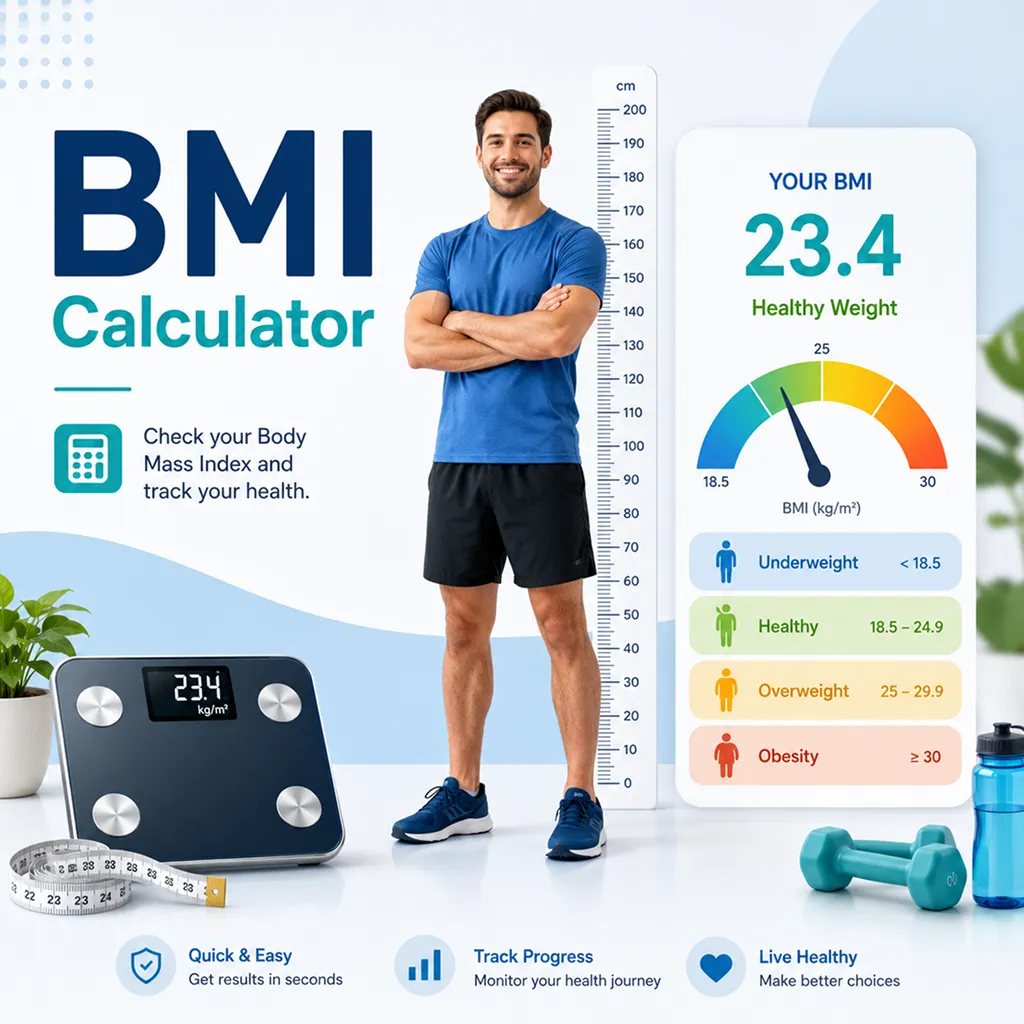
For adults 20 and older, BMI is commonly interpreted using the following categories:
- Underweight: BMI below 18.5
- Healthy Weight: BMI 18.5 to less than 25
- Overweight: BMI 25 to less than 30
- Class 1 Obesity: BMI 30 to less than 35
- Class 2 Obesity: BMI 35 to less than 40
- Class 3 Obesity: BMI 40 or greater
Healthy BMI Range
A healthy BMI range for most adults is generally from 18.5 to less than 25. Instead of only showing your BMI score, this calculator also estimates the approximate healthy weight range for your height. This makes the result easier to understand because you can see the weight range that corresponds to a healthy adult BMI.
If your BMI is above the healthy range, the calculator shows approximately how many pounds would need to change to reach the upper end of the healthy BMI range. If your BMI is below the healthy range, it shows the approximate gain needed to reach the lower boundary. This is only a mathematical estimate, not a personal medical target.
BMI Calculator for Men and Women
The adult BMI formula is the same for men and women. A BMI calculator for menand a BMI calculator for women use the same height and weight equation. However, BMI does not show body composition. Two people with the same BMI can have different amounts of muscle, body fat, and abdominal fat.
This is why BMI should be treated as a screening number rather than a complete health assessment. Athletes, highly muscular people, older adults, pregnant people, and people with certain medical conditions may need additional measurements beyond BMI.
When BMI Is Useful
BMI is useful when you want a quick weight-for-height estimate. A BMI calculator can be helpful for:
- Checking your adult BMI category quickly
- Comparing weight changes over time
- Estimating a healthy weight range for your height
- Understanding whether your BMI is near a category boundary
- Using a simple screening number before reviewing other health indicators
Limitations of BMI
BMI does not directly measure body fat percentage. It also does not show where fat is stored, which can matter because waist size and abdominal fat may be important health indicators. BMI also does not account for muscle mass, age-related body composition changes, pregnancy, or individual medical history.
For a fuller picture, BMI may be considered together with waist circumference, blood pressure, cholesterol, blood sugar, fitness level, diet, sleep, family history, and medical history. This calculator is for general educational use and should not be used to diagnose obesity, eating disorders, malnutrition, or any medical condition.
BMI FAQ
- Q. What is BMI?A. BMI stands for Body Mass Index. It is a number calculated from height and weight and is commonly used as a screening tool for adult weight categories.
- Q. What is a good BMI?A. For most adults, a BMI from 18.5 to less than 25 is commonly classified as the healthy weight range. However, a good BMI can depend on body composition, medical history, and other health factors.
- Q. What BMI is overweight?A. For adults, BMI 25 to less than 30 is commonly classified as overweight. BMI 30 or greater falls into the obesity range.
- Q. Is BMI different for men and women?A. The BMI formula is the same for adult men and women. However, body composition can differ, so BMI should be interpreted together with other health information.
- Q. Can this calculator be used for children or teens?A. This calculator can calculate the BMI number, but adult BMI categories should not be used to classify children or teens. Children and teens are usually evaluated using age- and sex-specific BMI percentiles.
- Q. Why does this BMI calculator use pounds and inches first?A. Since this page targets users in the United States, the default input uses pounds, feet, and inches. Metric input is also available for users who prefer centimeters and kilograms.
- Q. Is BMI a diagnosis?A. No. BMI is a screening tool, not a diagnosis. For personal health decisions, it is best to speak with a qualified healthcare professional.