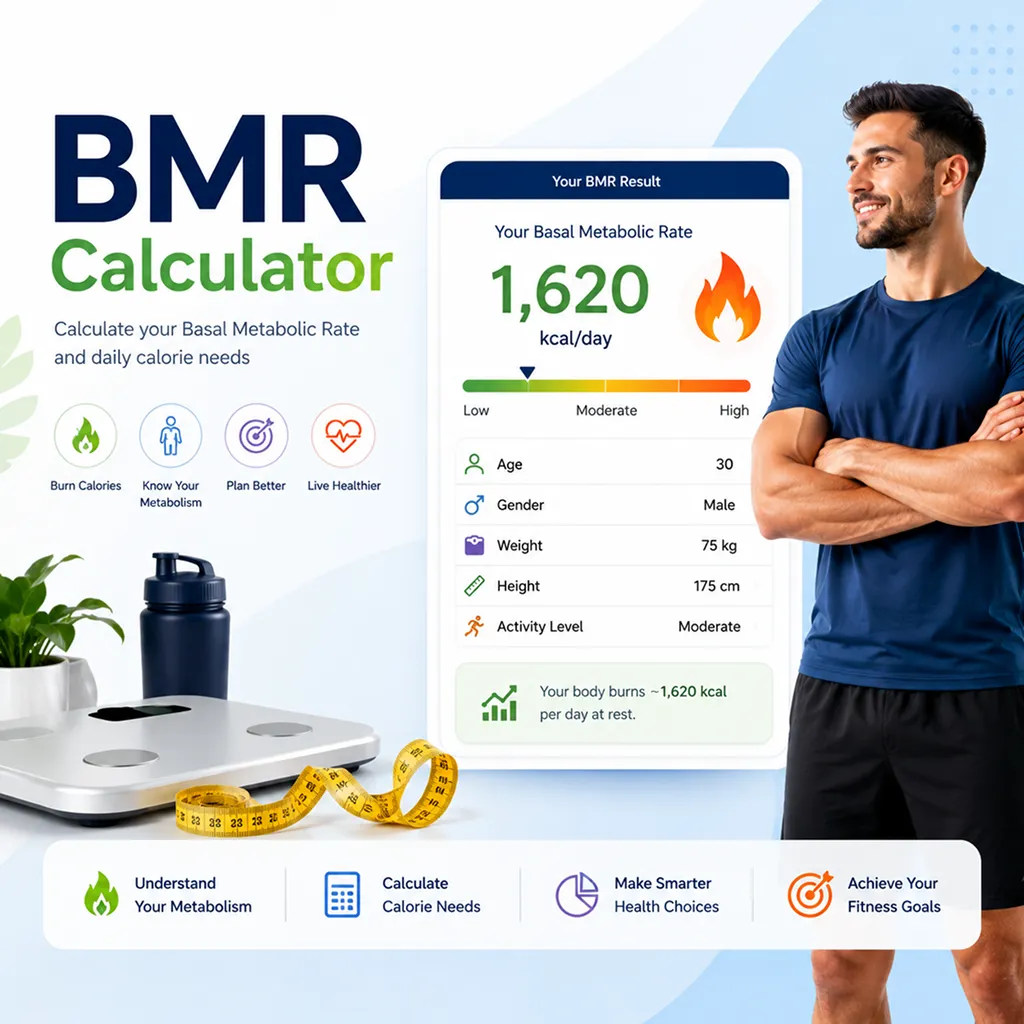
Use this BMR Calculator to estimate how many calories your body burns per day at rest. Enter your age, sex, height, and weight in either US units or metric units, then compare your BMR with an estimated daily calorie target.
- BMR is your resting calorie burn. TDEE is your estimated full-day calorie burn after activity. For most weight goals, BMR is only the starting point. Your activity level, body composition, sleep, and consistency can change your real calorie needs.
What Is BMR?
BMR, or Basal Metabolic Rate, is the estimated number of calories your body burns each day while at complete rest. In other words, it is the energy your body needs to keep essential functions running, such as breathing, blood circulation, body temperature regulation, brain activity, cell repair, and organ function.
A BMR Calculator helps you estimate your resting calorie burn based on your age, sex, height, and weight. This number is useful when you want to understand your metabolism, estimate your daily calorie needs, or create a starting point for weight loss, weight gain, or maintenance calories.
This calculator is designed for both US units and metric units. If you live in the United States, you can enter your height in feet and inches and your weight in pounds. Metric users can switch to centimeters and kilograms.
BMR Calculator for Daily Calorie Needs
Your BMR is not the same as the total number of calories you burn in a normal day. It only estimates the calories your body burns at rest. To estimate your full daily calorie needs, this calculator also applies an activity multiplier and shows your estimated TDEE, or Total Daily Energy Expenditure.
For example, if your BMR is 1,700 calories per day, your actual maintenance calories may be closer to 2,000–2,600 calories per day depending on your activity level. A desk worker, a recreational gym-goer, and a highly active athlete can have very different daily calorie needs even if their BMR is similar.
BMR vs TDEE: What Is the Difference?
BMR is your estimated calorie burn at rest. TDEE is your estimated total daily calorie burn after adding movement, exercise, walking, work, and everyday activity. For practical weight management, TDEE is usually more useful than BMR because it is closer to your real maintenance calorie target.
- BMR: calories your body may burn at rest.
- TDEE: calories your body may burn in a full day, including activity.
- Maintenance calories: the estimated calorie intake that keeps your weight stable.
BMR Formulas Used in This Calculator
This calculator includes two common BMR equations: the Mifflin-St Jeor equationand the Revised Harris-Benedict equation. The Mifflin-St Jeor formula is selected by default because it is widely used for modern calorie estimation. The Revised Harris-Benedict formula is also included for users who want to compare results with older fitness, nutrition, or weight loss calculators.
Mifflin-St Jeor Formula
In this formula,
W is weight in kilograms, H is height in centimeters, and A is age in years. If you enter pounds, feet, or inches, this calculator converts them internally before applying the formula.Revised Harris-Benedict Formula
How to Use Your BMR Result
Your BMR result is best used as a starting point, not as your final calorie target. For most people, the more practical number is the estimated TDEE shown in the result. From there, you can adjust calories based on your goal.
- Maintain weight: start near your estimated TDEE.
- Lose weight slowly: try a modest deficit, such as about 250 calories below TDEE.
- Lose weight more aggressively: a 500-calorie deficit is common, but it may not be appropriate for everyone.
- Gain weight gradually: try a small surplus, such as about 250 calories above TDEE.
After choosing a calorie target, track your body-weight trend for 2–4 weeks. If your weight is not changing in the expected direction, adjust your daily intake or activity gradually. Your real calorie needs can differ from calculator estimates because of muscle mass, sleep, dieting history, training intensity, medication, stress, and tracking accuracy.
Why This BMR Calculator Is Different
Many BMR calculators only show one resting calorie number. This calculator is designed to be more useful for real calorie planning by combining BMR, TDEE, activity level, and goal-based calorie targets in one result.
- Supports both US units and metric units.
- Calculates BMR with Mifflin-St Jeor or Revised Harris-Benedict.
- Converts BMR into estimated TDEE using your activity level.
- Shows practical calorie targets for fat loss, maintenance, and lean weight gain.
- Optionally estimates a body-fat adjusted BMR when you enter your body fat percentage.
BMR Calculator FAQ
- Q. What does BMR mean?A. BMR stands for Basal Metabolic Rate. It estimates how many calories your body burns per day at rest to support essential functions like breathing, circulation, temperature control, and organ function.
- Q. Is BMR the same as resting metabolic rate?A. BMR and Resting Metabolic Rate, or RMR, are similar but not exactly the same. BMR is usually measured under stricter resting conditions, while RMR is often measured under slightly less strict conditions. For everyday calorie planning, many people use the terms in a similar way, but the numbers may differ slightly.
- Q. Should I eat below my BMR to lose weight?A. Not necessarily. BMR is your estimated resting calorie need, not your full-day calorie burn. For most people, a moderate deficit below TDEE is more practical than simply eating below BMR. Very low calorie targets can be hard to sustain and may not be appropriate without professional guidance.
- Q. Which BMR formula should I choose?A. The Mifflin-St Jeor equation is a strong default for general adult calorie estimation. The Revised Harris-Benedict equation is useful if you want to compare against older BMR calculators, fitness plans, or nutrition resources that use that formula.
- Q. Why does body fat percentage matter?A. Muscle and lean tissue generally require more energy than fat tissue. If you know your body fat percentage, the optional body-fat adjusted estimate can provide another reference point based on lean body mass. However, body fat measurements can vary by device and method, so this should still be treated as an estimate.
- Q. Can I use this BMR calculator for weight loss?A. Yes. Use your BMR to understand your resting metabolism, then use the estimated TDEE and calorie target suggestions to create a more realistic weight loss plan. For most people, a consistent moderate deficit is easier to maintain than an extreme calorie cut.