What is a body fat calculator?
A body fat calculator estimates how much of your total body weight is fat mass. Unlike BMI, body fat percentage separates the idea of fat mass from lean body mass. Lean body mass is not the same as muscle mass: it includes muscle, bone, organs, body water, and other non-fat tissue.
This calculator is designed for adult body-composition estimates and has two modes. Estimate body fat % uses Relative Fat Mass (RFM), an adult equation based on height, waist circumference, and the sex variable used in the published formula. I know my body fat % skips the estimation step and uses the percentage you enter to calculate fat mass, lean mass, and the target-weight scenario.
How the RFM body fat estimate works
The RFM equation was developed and validated using U.S. National Health and Nutrition Examination Survey data and compared with whole-body fat percentage measured by DXA. The adult equation is:
In the published equation, sex = 0 for men and sex = 1 for women.
Height and waist must use the same length unit. Inches work with inches, and centimeters work with centimeters. Body weight is not used to estimate RFM itself; weight is used afterward to convert the estimated percentage into fat mass and lean body mass.
Body fat percentage, fat mass, and lean mass
Once body fat percentage is known or estimated, the calculator uses your body weight to separate fat mass and lean mass:
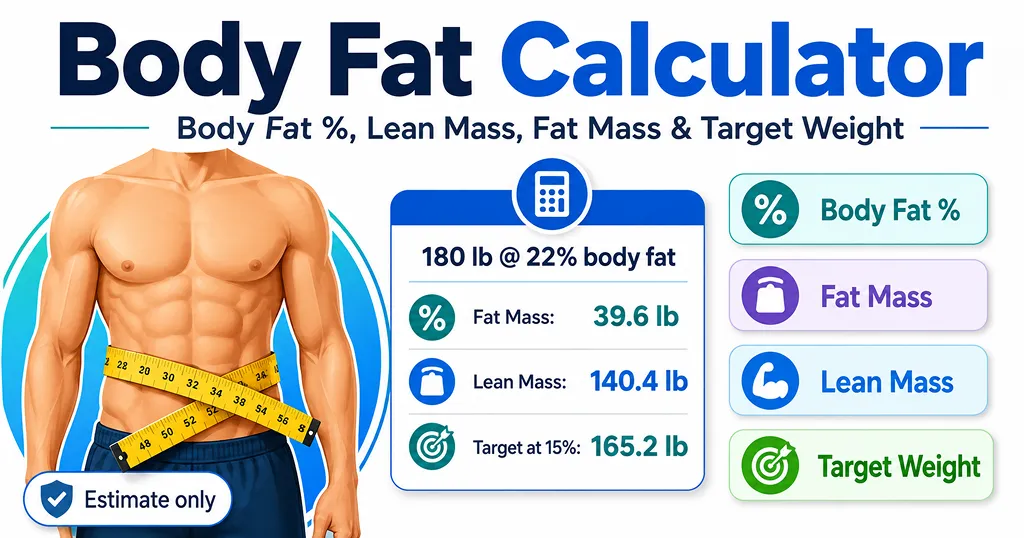
For example, if someone weighs 180 lb at 22% body fat, the calculation gives about 39.6 lb of fat mass and 140.4 lb of lean mass.
Target body fat and estimated target weight
The target-body-fat feature answers a different question: “What would my body weight be if my current lean body mass stayed unchanged?” It uses this equation:
Using the same 180 lb and 22% example, 140.4 lb of lean mass at a hypothetical 15% body fat would correspond to about 165.2 lb. This does not mean a person should target that weight or that all weight change will come from body fat. Lean tissue and body water can change during weight loss or gain.
Body fat percentage vs. BMI
BMI uses weight relative to height. It is quick and useful as a screening measure, but it does not directly measure body fat and does not distinguish fat mass from muscle and bone mass. A body-fat estimate can add a different view of body composition, but it also has measurement error and should not be treated as a diagnosis.
How to get a more consistent waist measurement
Because the estimate depends strongly on waist circumference, consistency matters. Use a flexible, non-stretch tape, keep it level around the body, avoid pulling it tightly into the skin, and measure at the same location each time. If you are tracking change over time, using the same method and time of day can be more useful than comparing results from different devices or formulas.
Limitations
This calculator provides an estimate for informational purposes and is not a medical diagnostic tool. RFM is an anthropometric equation, so an individual result can differ from DXA, air-displacement plethysmography, hydrostatic weighing, skinfold measurements, or bioelectrical-impedance devices. Hydration, measurement technique, device algorithms, and population differences can affect results. If body composition is important for medical treatment, sports eligibility, pregnancy, an eating disorder, or another health condition, use an appropriate clinical or professional assessment.
Sources
Frequently asked questions
- Q. Is body fat percentage the same as BMI?A. No. BMI is based on weight and height, while body fat percentage estimates the share of body weight that is fat. BMI does not directly distinguish fat mass from lean mass.
- Q. Why does my smart scale give a different body fat percentage?A. Different methods use different measurements and assumptions. Bioelectrical-impedance scales, tape-measure equations, calipers, and DXA can produce different values for the same person.
- Q. Does lean body mass mean muscle mass?A. No. Lean body mass includes muscle but also includes bone, organs, body water, and other non-fat tissues.
- Q. Is the target weight a recommended goal?A. No. It is a mathematical scenario that assumes lean body mass does not change. Actual weight change can involve both fat and lean tissue, so the result should not be used as a medical or nutrition prescription.