Car Payment Calculator: monthly auto loan payment, trade-in, and total interest
A car payment calculator estimates how much you may pay each month for an auto loan. The most useful estimate starts with more than the sticker price. A real purchase can include a cash down payment, a trade-in, an unpaid balance on the trade-in, sales tax, title or registration charges, documentation fees, and other financed items.
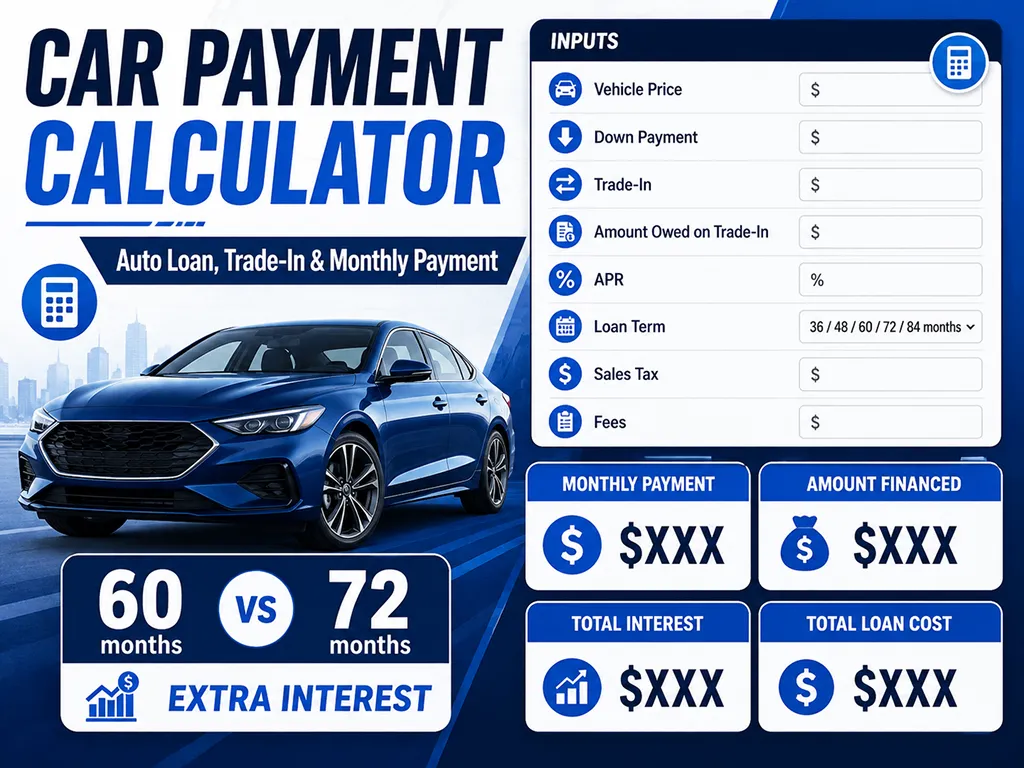
This calculator combines those items into an estimated amount financed, then applies your selected annual rate and loan term to calculate the monthly payment, total loan payments, and total interest. It also compares common 36-, 48-, 60-, 72-, and 84-month terms using the same financed amount and rate.
How the car payment is calculated
For a standard fixed-payment installment loan, the monthly payment is estimated with the amortization formula below:
is the monthly payment, is the amount financed, is the monthly rate, and is the number of monthly payments. If the annual rate is 0%, the calculator simply divides the amount financed by the number of months.
How trade-in value and an existing loan affect financing
The trade-in value does not always equal the amount that reduces your new loan. If your old vehicle is worth more than its payoff balance, you have positive trade-in equity. If you owe more than the vehicle is worth, you have negative equity.
This calculator estimates the financed amount as:
For example, a $10,000 trade-in with a $4,000 payoff contributes $6,000 of positive equity. A $10,000 trade-in with a $13,000 payoff has $3,000 of negative equity; if that balance is rolled into the new loan, the new amount financed increases by $3,000.
60 months vs. 72 months: why the lower payment can cost more
A longer term usually reduces the monthly payment because the principal is spread over more payments. The tradeoff is that interest has more time to accrue. That is why the calculator shows the 60-month and 72-month difference in both monthly payment and total interest, rather than highlighting the monthly payment alone.
The comparison table also includes 36, 48, and 84 months. Shorter terms generally require a higher monthly payment but can reduce total interest. Longer terms can improve monthly cash flow, but they can increase lifetime borrowing cost and may leave the loan balance high for longer.
Sales tax and fees
Vehicle sales tax, registration charges, title fees, and dealer fees vary by location and transaction. Some jurisdictions may calculate vehicle tax differently when a trade-in is involved. For that reason, this calculator does not assume one nationwide tax rule. Enter the tax rate that applies to your quote and choose whether your estimated tax applies to the full vehicle price or the vehicle price after the trade-in value.
If your dealer quote provides the exact tax amount rather than a rate, you can approximate the rate from the taxable purchase amount or use the calculator as a loan-payment estimate and compare the final financed amount with the lender's disclosure.
APR, interest rate, and your lender's disclosure
An auto loan's interest rate is the cost of borrowing expressed as a percentage. APR is a broader measure that can include certain finance charges in addition to interest. This tool uses the entered APR as an annual rate divided by 12 for the payment estimate, so the result may not exactly match a lender's Truth in Lending disclosure when additional finance charges are included in the disclosed APR.
When comparing offers, look at the amount financed, APR, loan term, monthly payment, and total cost together. A lower monthly payment is not automatically the cheaper loan.
What is loan-to-value (LTV)?
The calculator also shows a simple estimated loan-to-value ratio by dividing the amount financed by the vehicle price. An LTV above 100% means the estimated loan balance is larger than the vehicle price. Taxes, financed fees, add-ons, and negative equity can all push the financed amount above the purchase price.
Ways to reduce a car payment or total interest
- Increase the down payment: borrowing less generally lowers the monthly payment and total interest.
- Negotiate the vehicle price: a lower purchase price reduces the amount that must be financed.
- Shop for a lower rate: compare bank, credit union, finance company, and dealer financing offers when available.
- Choose a shorter term if affordable: the payment may be higher, but total interest can be lower.
- Review add-ons and fees: financed optional products increase the loan balance and can also increase interest paid over time.
Frequently asked questions
- Q. Does a trade-in always reduce my new car loan?A. Not necessarily. If the trade-in is worth more than the amount you still owe, the positive equity can reduce the new financed amount. If you owe more than the trade-in is worth, rolling that negative equity into the new loan increases the amount financed.
- Q. Is a 72-month car loan cheaper than a 60-month loan?A. It usually has a lower monthly payment when the financed amount and rate are the same, but it generally produces more total interest because the balance is repaid over a longer period. Use the comparison table to see the difference for your inputs.
- Q. Should sales tax be calculated before or after the trade-in?A. Vehicle tax treatment varies by state and locality. Use the option that matches your local rule or dealer quote rather than assuming one nationwide method.
- Q. Does this calculator include insurance and fuel?A. No. The result estimates the auto loan payment. Your full monthly vehicle budget may also include auto insurance, fuel or charging, maintenance, parking, tolls, registration renewals, and other ownership costs.
- Q. Why might my lender's payment be different?A. The lender may use a different financed amount, exact fee treatment, payment date convention, interest calculation method, add-on products, or disclosed APR. Always use the signed contract and Truth in Lending disclosure as the final source.
Sources and references
For U.S. auto-loan terminology and comparison guidance, see the Consumer Financial Protection Bureau resources on auto-loan key terms, comparing loan offers, loan-to-value, and trade-ins with negative equity, plus the Federal Trade Commission's consumer guidance on vehicle financing.
This calculator is for estimation and comparison only. Actual vehicle taxes, fees, APR, interest calculation, payment schedule, trade-in payoff, lender requirements, and contract terms can differ. Confirm final figures with your dealer, lender, and purchase documents.