
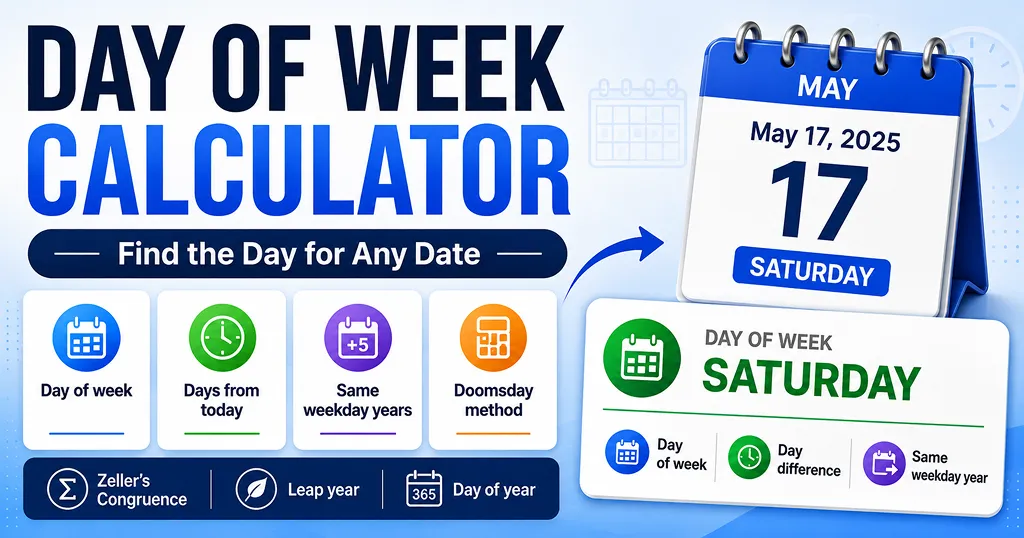
What is a Day of Week Calculator?
A Day of Week Calculator finds the weekday for a calendar date. Enter a month, day, and year to see whether that date falls on a Monday, Tuesday, Wednesday, Thursday, Friday, Saturday, or Sunday. It is useful for birthdays, anniversaries, historical dates, deadlines, event planning, and calendar research.
This calculator also shows the number of days between the selected date and today, the next years when the same month and day land on the same weekday, and two classic ways to calculate a weekday by hand: Zeller's Congruence and the Doomsday Method.
How to calculate the day of the week from a date
A calendar date can be converted to a weekday because the seven-day week repeats in a fixed cycle. A common year has 365 days, which is 52 weeks plus 1 day, so the weekday normally moves forward by one day from one year to the next. A leap year has 366 days, adding another weekday shift after February 29.
The Gregorian leap-year rule is important: a year divisible by 4 is normally a leap year, but a century year must also be divisible by 400. That is why 2000 was a leap year while 1900 was not. Weekday formulas account for these leap-day shifts with modular arithmetic.
Day of week formula: Zeller's Congruence
Zeller's Congruence is a well-known formula for finding the day of the week from a date. For the Gregorian calendar, January and February are treated as months 13 and 14 of the previous year. The formula then combines the day, adjusted month, year within the century, and century number, and reduces the result modulo 7.
h = (q + floor(13(m + 1) / 5) + K + floor(K / 4) + floor(J / 4) + 5J) mod 7
In this version,
q is the day of the month, m is the adjusted month, K is the year within the century, and Jis the century. Zeller's output uses 0 for Saturday, 1 for Sunday, through 6 for Friday.How the Doomsday Method works
The Doomsday Method, developed by mathematician John Conway, is designed for mental day-of-week calculation. Each year has one weekday called its Doomsday. Several easy-to-remember dates always fall on that weekday in the same year, including 4/4, 6/6, 8/8, 10/10, 12/12, 5/9, 9/5, 7/11, and 11/7.
To find a date's weekday, first calculate the century anchor and the year's Doomsday. Then use the nearest monthly anchor date and count the difference modulo 7. The calculator above exposes every step, so it can be used as both a date calculator and a practice tool for learning the Doomsday Method.
Why the same date does not repeat every 7 years
It may seem that a date should return to the same weekday every seven years, but leap years interrupt that pattern. A common year shifts the weekday by one day, while a leap year can shift dates after February by two days. As a result, the same month and day can return to the same weekday after 5, 6, 11, or other intervals depending on where leap years fall.
Gregorian calendar note for historical dates
This tool uses the proleptic Gregorian calendar, meaning Gregorian rules are extended backward for calculation consistency. The Gregorian calendar was introduced in 1582 and adopted at different times in different places, so a historical document may use a Julian-calendar weekday instead for dates before local adoption.
Frequently asked questions
- Q. How do I find the day of the week for any date?A. Enter the date above and select Find Day of Week. The calculator returns the weekday and independently checks it with Zeller's Congruence and the Doomsday Method.
- Q. Can I calculate a weekday without a calendar?A. Yes. Zeller's Congruence provides a direct formula, while Conway's Doomsday Method is designed to make mental weekday calculation easier by using memorable anchor dates.
- Q. Why do January and February use the previous year in Zeller's formula?A. Treating January and February as months 13 and 14 places February at the end of the adjusted year, which makes leap-day handling fit cleanly into the formula.
- Q. When will my birthday fall on the same weekday again?A. The result table checks future years directly. The interval varies because leap years change the weekday shift, and February 29 can occur only in leap years.
- Q. Does this calculator work for dates before 1582?A. It can calculate them using proleptic Gregorian rules. For historical research, remember that many places used the Julian calendar before adopting the Gregorian calendar, so the historically recorded weekday may differ.