What is a debt-to-income ratio?
Your debt-to-income ratio (DTI) compares your recurring monthly debt payments with your gross monthly income, which generally means income before taxes and other deductions. Lenders use DTI as one factor when evaluating whether a borrower can manage an additional monthly payment.
Debt-to-income ratio formula
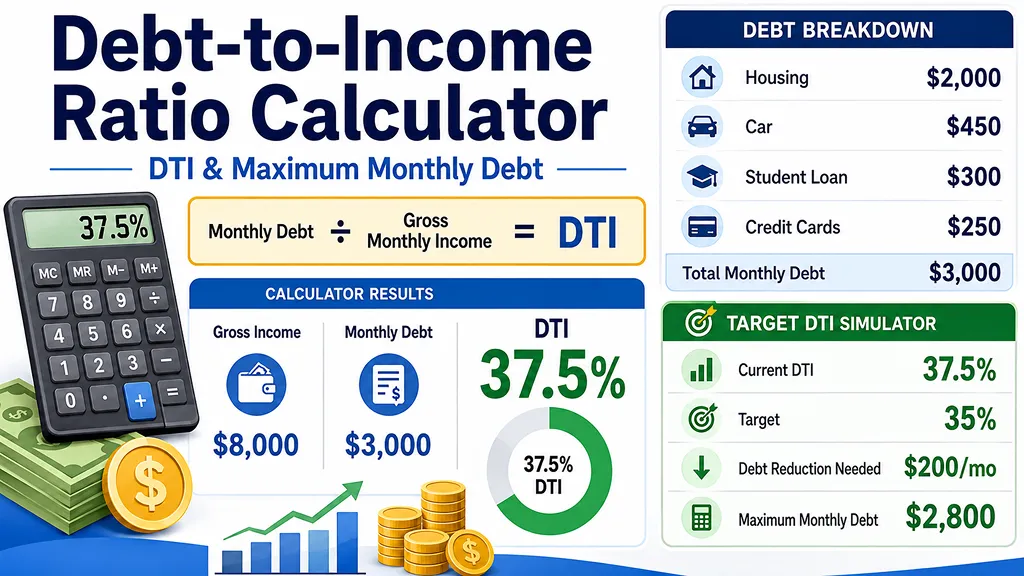
For example, if your gross monthly income is $8,000 and your recurring monthly debt payments total $3,000, your DTI is 37.5%.
What monthly payments should you include?
A practical DTI estimate starts with recurring obligations such as housing, auto loans, student loans, credit card minimum payments, personal loans, leases, and other recurring monthly debt payments. Mortgage underwriting can use more specific definitions for qualifying housing payments and other liabilities, so a lender’s final DTI may differ from a personal estimate.
Credit cards are an especially common source of confusion. For a DTI estimate, the relevant figure is generally the required monthly payment, not your entire outstanding card balance.
How the Target DTI Simulator works
Instead of only showing your current percentage, this calculator lets you enter a target DTI and reverse the formula. The result estimates the maximum total monthly debt that fits that target:
If your current debt is higher than that amount, the calculator shows the monthly debt reduction needed to reach the target. If your current debt is lower, it shows the remaining monthly debt room. It also estimates the maximum housing payment that would fit the target if your non-housing debt stayed unchanged.
DTI example: $8,000 income and $3,000 monthly debt
With $8,000 of gross monthly income and $3,000 of monthly debt, DTI is 37.5%. At a target DTI of 35%, maximum monthly debt would be $2,800, meaning monthly debt would need to decrease by $200 to reach that target, assuming income stays the same.
Is there one "good" DTI ratio?
There is no single DTI cutoff that applies to every loan. The Consumer Financial Protection Bureau notes that different lenders and loan products can have different DTI limits. For conventional mortgage context, Fannie Mae’s current Selling Guide states that manually underwritten loans generally use a 36% maximum total DTI, with certain cases allowed up to 45% when specified credit-score and reserve requirements are met. Loan casefiles underwritten through Desktop Underwriter can have a maximum allowable DTI of 50%.
Those percentages are underwriting rules for particular mortgage scenarios, not universal personal-finance targets. Your credit profile, reserves, loan type, property expenses, interest rate, income stability, and lender rules can all affect qualification.
DTI vs. housing ratio
Total DTI includes housing plus other recurring debt. A housing-to-income ratio looks only at the housing payment compared with gross income. This calculator shows both so you can see whether housing or non-housing debt is contributing more to the total ratio.
How to lower your DTI
Mathematically, DTI falls when recurring monthly debt payments decrease, gross monthly income increases, or both. Paying off an installment loan, reducing required revolving-debt payments, avoiding new monthly obligations, or increasing qualifying income can change the ratio. The most useful strategy depends on the loan rules and your broader budget, so DTI should not be treated as the only measure of affordability.
Frequently asked questions
- Q. Is DTI based on gross income or take-home pay?A. DTI is generally calculated using gross monthly income before taxes and other deductions.
- Q. Do I enter my total credit card balance?A. No. For a basic DTI estimate, enter the recurring required monthly payment rather than the full account balance. Lenders may apply their own rules when determining the qualifying payment.
- Q. Why might a lender calculate a different DTI?A. Mortgage underwriting can include specific rules for housing expenses, installment debt, revolving debt, leases, support obligations, rental-property losses, qualifying income, and other liabilities. A lender also verifies the income and debt figures used for qualification.
- Q. Does being under the target DTI mean I will be approved?A. No. DTI is only one part of underwriting. Credit history, loan-to-value, assets, reserves, income documentation, loan program requirements, and other factors can affect approval.
- Sources: Consumer Financial Protection Bureau (CFPB), “What is a debt-to-income ratio?”; Fannie Mae Selling Guide B3-6-02, “Debt-to-Income Ratios.” This calculator is for educational estimates only and does not provide lending, legal, tax, or financial advice. Your lender’s qualifying DTI may differ.