
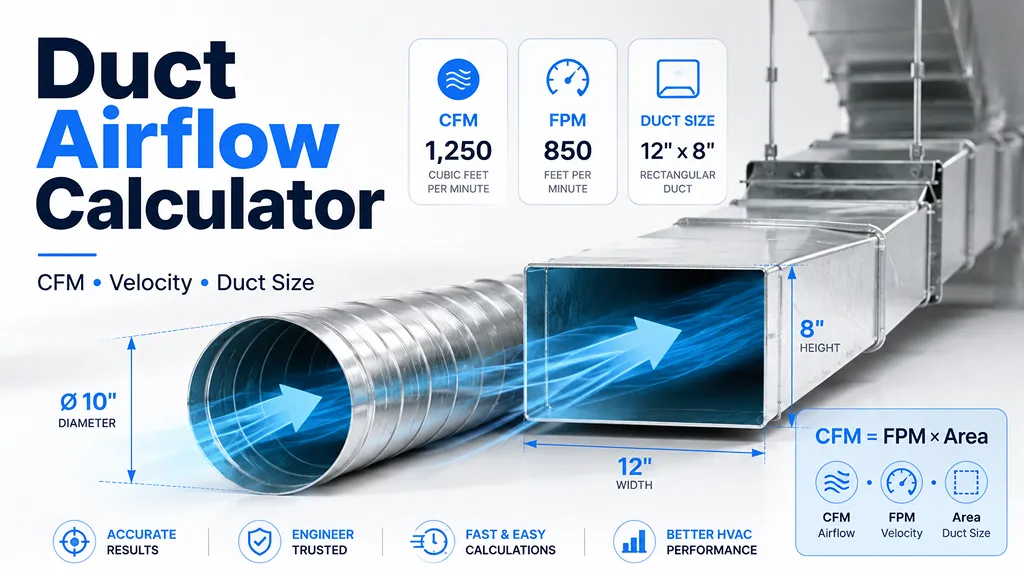
Calculate duct airflow from duct size and air velocity, or work backward from airflow to duct velocity. This calculator is built for common U.S. HVAC units such as CFM, FPM, and inches, while also supporting metric units.
What is duct airflow?
Duct airflow is the amount of air moving through an HVAC duct over a period of time. In U.S. HVAC work, it is most commonly measured in CFM, or cubic feet per minute. For example, a duct carrying 400 CFM moves about 400 cubic feet of air through the duct every minute.
Duct airflow is closely related to duct size and air velocity. A larger duct can move the same CFM at a lower velocity, while a smaller duct must move the air faster to carry the same airflow. This is why duct sizing affects comfort, noise, static pressure, and how well air reaches each room.
This duct airflow calculator helps you estimate airflow from duct size and air velocity, or calculate duct velocity from a known airflow value. It supports round ducts, rectangular ducts, CFM, FPM, inches, feet, metric units, and optional ACH estimation for room ventilation checks.
Duct airflow calculator formula
The basic duct airflow formula is:
CFM = duct velocity (FPM) × duct area (ft²)
If you already know the airflow and want to calculate duct velocity, use:
Duct velocity (FPM) = CFM ÷ duct area (ft²)
The calculator first converts the duct dimensions into square feet, then applies the airflow formula. This makes it easy to work with common HVAC measurements such as 6-inch round ducts, 8-inch round ducts, 10 × 6 rectangular ducts, or metric duct sizes.
Round duct airflow calculation
For a round duct, airflow is based on the circular cross-sectional area of the duct.
Round duct area = π × (diameter ÷ 2)²
After the duct area is calculated, the area is multiplied by air velocity to estimate CFM. For example, a larger round duct at the same FPM will produce a higher CFM result because it has more open area for air to pass through.
Rectangular duct airflow calculation
For a rectangular duct, the area is calculated from width and height.
Rectangular duct area = width × height
Rectangular ducts are common when ceiling space, wall space, or equipment layout makes round ductwork difficult. However, two ducts with the same area may not perform exactly the same in real installations. Duct length, elbows, transitions, dampers, filters, grilles, and duct leakage can all affect delivered airflow.
CFM to FPM: calculate duct velocity from airflow
Use the CFM → Velocity mode when you know the airflow and want to check how fast air is moving through the duct.
- Choose CFM → Velocity.
- Select round duct or rectangular duct.
- Enter the duct diameter, or enter width and height.
- Enter airflow in CFM, m³/h, m³/min, m³/s, or L/s.
- Check the calculated duct velocity in FPM or another selected velocity unit.
This is useful when checking whether a duct may be moving air too slowly or too quickly. Higher duct velocity may allow a smaller duct, but it can also increase noise and pressure loss.
FPM to CFM: calculate airflow from duct velocity
Use the Velocity → CFM mode when you know duct size and measured or estimated air velocity.
- Choose Velocity → CFM.
- Enter the duct size.
- Enter air velocity in FPM, ft/s, m/s, mph, or km/h.
- Choose the result airflow unit.
- Review the calculated CFM and duct area.
This mode is helpful when using an anemometer, checking a ventilation duct, estimating exhaust fan airflow, or comparing airflow through different duct sizes.
Why CFM and FPM matter in HVAC duct sizing
CFM tells you how much air is being delivered, while FPM tells you how fast that air is moving inside the duct. Both values matter because airflow affects room comfort, and velocity affects noise, pressure loss, and duct performance.
If the duct is too small for the required CFM, air velocity can become high. This may cause noise, whistling, vibration, and reduced system efficiency. If the duct is much larger than needed, velocity may become very low, which can make the duct bulky and may affect air distribution depending on the system design.
Same-area round diameter and hydraulic diameter
This calculator also shows the same-area round diameter. This is the diameter of a round duct that has the same cross-sectional area as the duct you entered. It is useful when comparing a rectangular duct with a round duct at a quick estimate level.
For rectangular ducts, the calculator can also show hydraulic diameter. Hydraulic diameter is often used as a reference when comparing non-round ducts, but it is not a full replacement for duct design. Real duct sizing should still account for friction loss, fittings, equivalent length, and available static pressure.
Optional ACH estimate
If you enter room dimensions, the calculator can estimate ACH, or air changes per hour. ACH compares airflow with the volume of a room.
ACH = CFM × 60 ÷ room volume (ft³)
For example, if a room is 1,000 ft³ and the duct supplies 100 CFM, the estimated air changes per hour are:
100 × 60 ÷ 1,000 = 6 ACH
ACH can be helpful for a quick ventilation check, but it does not prove that the room is properly ventilated. Outdoor air intake, filtration, air mixing, exhaust, leakage, equipment performance, and local code requirements may also need to be considered.
Common uses for a duct airflow calculator
- Estimating CFM through a round supply duct
- Checking air velocity in a rectangular return duct
- Comparing duct sizes for the same airflow
- Estimating exhaust duct airflow for bathrooms, kitchens, workshops, or utility rooms
- Checking whether a duct velocity looks unusually high or low
- Estimating ACH for a simple room ventilation comparison
- Converting between CFM, FPM, m/s, m³/h, and L/s
Important notes before using the result
- This calculator uses duct cross-sectional area and average air velocity. It does not calculate friction loss, equivalent length, static pressure, fan curve performance, register throw, or system balancing.
- Actual airflow can differ from the calculated value because of duct leakage, flex duct compression, dirty filters, closed dampers, undersized returns, elbows, transitions, grilles, and blower settings.
- Use the result as a quick estimate. For real HVAC design, verify duct sizing with Manual D, ASHRAE guidance, manufacturer data, local code, and field measurements.
- Use internal duct dimensions whenever possible. Insulation, liner, wall thickness, or crushed flexible duct can reduce the actual open area available for airflow.
Frequently asked questions
- Q. What is duct airflow?A. Duct airflow is the volume of air moving through a duct over time. In U.S. HVAC work, it is usually measured in CFM, or cubic feet per minute.
- Q. Is CFM the same as air velocity?A. No. CFM measures airflow volume, while FPM measures air speed. A large duct and a small duct can carry the same CFM, but the smaller duct will need a higher air velocity.
- Q. How do you calculate duct CFM?A. Multiply duct velocity in FPM by duct area in square feet. The formula is CFM = FPM × ft².
- Q. How do you calculate duct velocity from CFM?A. Divide CFM by duct area in square feet. The formula is FPM = CFM ÷ ft².
- Q. Why does duct velocity increase when duct size gets smaller?A. For the same airflow, a smaller duct has less area for the air to pass through. The air must move faster to carry the same CFM.
- Q. Can I use this as a duct size calculator?A. You can use the quick sizing table for rough comparison, but full duct sizing should also consider static pressure, duct length, fittings, equipment airflow, noise, and code requirements.
- Q. Should I use inside duct dimensions or outside dimensions?A. Use the internal airflow opening whenever possible. Outside dimensions may overstate the true open area, especially when duct liner, insulation, or wall thickness is present.