What is a fraction calculator?
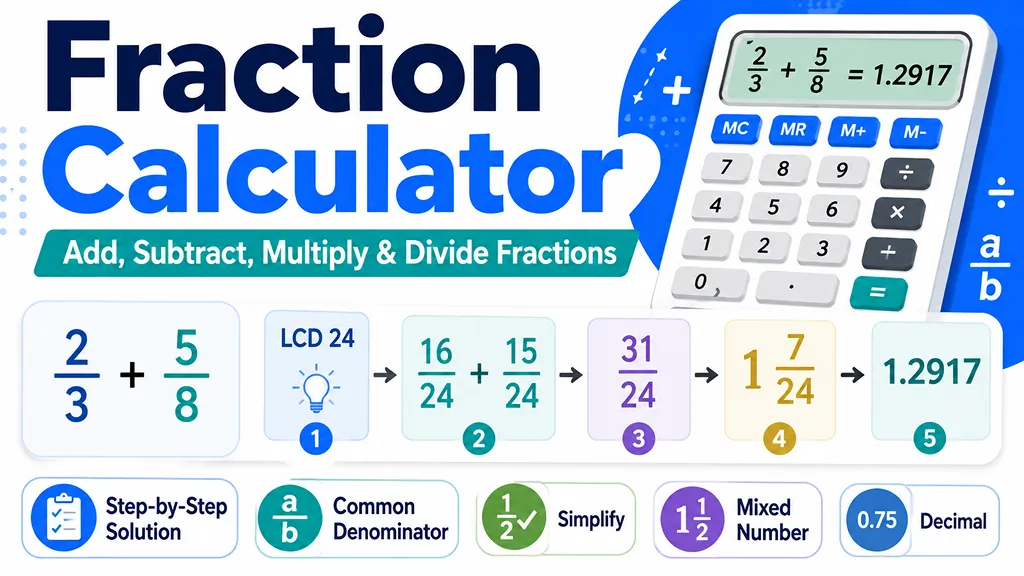
A fraction calculator solves arithmetic with fractions while keeping the answer exact. This calculator can add, subtract, multiply, and divide fractions, then reduce the result to simplest form. It also converts improper fractions to mixed numbers and shows decimal and percentage equivalents.
Unlike a basic calculator that may show only a decimal, the step-by-step solution keeps the numerator and denominator visible throughout the calculation. That makes it useful for homework checks, fraction practice, recipes, measurements, and any situation where an exact fractional answer matters.
How to add fractions
To add fractions with different denominators, first find a common denominator. The smallest convenient choice is the least common denominator (LCD), which is the least common multiple of the denominators. Rewrite both fractions as equivalent fractions with that denominator, add the numerators, keep the denominator, and simplify the result.
How to subtract fractions
Fraction subtraction follows the same denominator rule as addition. Find the LCD, convert each fraction to an equivalent fraction with that denominator, subtract the numerators, and reduce the answer if possible.
How to multiply fractions
To multiply fractions, multiply the numerators together and multiply the denominators together. A common denominator is not needed. You can often make the arithmetic easier by cross-canceling common factors before multiplying, then simplify the final fraction.
How to divide fractions
To divide by a fraction, multiply by its reciprocal. In other words, keep the first fraction, flip the second fraction, and multiply. The second fraction cannot be zero because division by zero is undefined.
How mixed numbers are calculated
A mixed number combines a whole number and a proper fraction, such as 2 3/4. For fraction arithmetic, mixed numbers can be converted to improper fractions first. Multiply the whole number by the denominator, add the numerator, and keep the same denominator.
How to simplify a fraction
A fraction is in simplest form when its numerator and denominator have no common factor greater than 1. One reliable method is to find the greatest common divisor (GCD) and divide both parts of the fraction by it. For example, the GCD of 18 and 24 is 6, so 18/24 simplifies to 3/4.
Fraction to decimal and percent
To convert a fraction to a decimal, divide the numerator by the denominator. To convert that decimal to a percentage, multiply by 100. For example, 3/4 equals 0.75, which equals 75%. Some fractions create repeating decimals, so the decimal and percentage shown by this calculator may be rounded while the fraction remains exact.
Fraction examples
Add
Subtract
Multiply
Divide
Frequently asked questions
- Q. Can this calculator handle mixed numbers?A. Yes. Enter a mixed number with a space between the whole number and fraction, such as 1 3/4. You can also enter improper fractions such as 7/4 or whole numbers such as 5.
- Q. Do I need a common denominator to multiply fractions?A. No. A common denominator is needed for addition and subtraction, not multiplication or division. For multiplication, multiply numerator by numerator and denominator by denominator, then simplify.
- Q. What is the LCD of two fractions?A. The least common denominator is the least common multiple of the two denominators. It is the smallest denominator that both fractions can be rewritten to use.
- Q. Why do you flip the second fraction when dividing?A. Division by a nonzero fraction is equivalent to multiplication by its reciprocal. For example, dividing by 2/3 is the same as multiplying by 3/2.
- Q. Can a denominator be zero?A. No. A fraction with a denominator of zero is undefined, so the calculator rejects any input with 0 in the denominator. It also prevents division by a fraction whose value is zero.
- Q. Why is the decimal rounded but the fraction is exact?A. Some rational numbers have repeating decimal expansions. The calculator keeps the simplified fraction as the exact result and rounds only the decimal and percent display when necessary.