Overtime Calculator: Hourly Rate, Overtime Pay & Weekly Earnings
This overtime calculator is designed for hourly workers who want to answer questions such as “how do I calculate my overtime rate per hour?”, “how much will I make with 8 hours of overtime?”, and “how many overtime hours do I need to reach a target paycheck?” Enter your regular hourly rate and total hours worked, then choose an overtime multiplier to estimate regular pay, overtime pay, total weekly earnings, and your effective hourly rate.
How to calculate overtime rate per hour
For a simple hourly-pay example with no additional compensation, the calculation is:
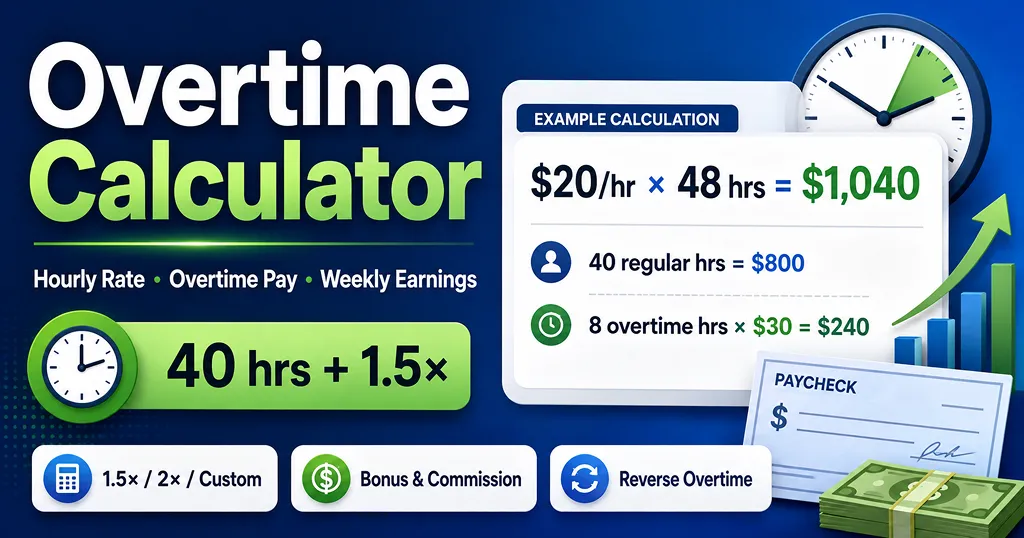
With a $20 hourly rate, 48 hours worked, a 40-hour threshold, and a 1.5× multiplier, the overtime rate is $30 per hour. The first 40 hours produce $800 of regular pay, 8 overtime hours produce $240 of overtime pay, and estimated total weekly pay is $1,040.
What is the FLSA overtime rule?
Under the federal Fair Labor Standards Act (FLSA), covered, nonexempt employees generally must receive overtime pay at not less than one and one-half times their regular rate for hours worked over 40 in a workweek. The federal rule is based on a workweek, not simply whether the employee worked on a Saturday, Sunday, holiday, or scheduled day off.
The 40-hour setting in this calculator is therefore the default. However, some workers may be subject to different state or local rules, special industry rules, exemptions, union contracts, or employer policies. The “Overtime starts after” field can model a different weekly threshold, but this calculator does not separately stack daily and weekly overtime rules and does not determine which law applies to you.
Regular hourly rate vs. regular rate of pay
Your stated hourly wage and your legal regular rate of pay are not always the same number. The U.S. Department of Labor explains the regular rate as total compensation that must be included for the workweek divided by total hours actually worked. This matters when a worker receives additional compensation such as certain bonuses, commissions, shift differentials, or other payments that must be included in the regular rate.
That is why this calculator shows both Base hourly rate and Regular rate used. If you enter a weekly nondiscretionary bonus or commission and choose “Include in regular rate,” the calculator spreads that includable compensation across the hours worked before calculating the overtime rate.
How bonuses and commissions can change overtime pay
A bonus is not automatically included or excluded from the overtime calculation. Under FLSA guidance, nondiscretionary bonuses generally must be included in the regular rate, while certain qualifying discretionary bonuses and other statutory exclusions may be left out. Commissions can also affect the regular rate depending on the circumstances.
Use Include in regular rate when the payment should be part of regular-rate compensation for that week. Use Add separately after overtime calculation only when the payment is properly excludable or when you are modeling a separate employer payment. If you are unsure how a specific bonus should be treated, confirm with your payroll department, applicable labor agency, or a qualified professional.
What is the overtime premium?
“Time and a half” can be viewed as straight-time pay plus an additional 0.5× overtime premium. For example, if the regular rate is $20 per hour, the 1.5× overtime rate is $30. Of that amount, $20 represents straight-time compensation and $10 represents the additional overtime premium. The calculator displays the overtime premium separately so you can see how much of the overtime pay comes from the multiplier above 1.0×.
Reverse Overtime Calculator: how many overtime hours do I need?
The reverse calculator starts with a target instead of a number of hours. For example, if your hourly rate is $20, overtime begins after 40 hours, the multiplier is 1.5×, and you want to earn $1,200 before deductions, the calculator solves for the total hours and overtime hours needed to reach that target under the entered assumptions.
This is useful for planning a weekly earnings goal, comparing voluntary overtime opportunities, or estimating whether a target paycheck is realistic. It is a gross-pay estimate and does not subtract federal income tax, state tax, Social Security, Medicare, insurance premiums, retirement contributions, garnishments, or other payroll deductions.
Overtime pay example: $20/hour for 48 hours
Here is the basic example used by the calculator when there is no bonus or commission:
- Regular hourly rate: $20.00
- Total hours worked: 48
- Regular hours: 40
- Overtime hours: 8
- Overtime multiplier: 1.5×
- Overtime hourly rate: $30.00
- Regular pay:
- Overtime pay:
- Total weekly pay: $1,040
Does overtime start after 8 hours in a day?
The federal FLSA generally uses a 40-hour workweek standard for covered, nonexempt employees. It does not create a general federal requirement for overtime merely because an employee worked more than 8 hours in one day. Some states and specific employment arrangements can have daily overtime or other rules, so the correct threshold depends on the law and policy that applies to your job.
Does weekend or holiday work automatically count as overtime?
Not under the general federal FLSA rule. Working Saturday, Sunday, a holiday, or a scheduled day off does not by itself create a federal overtime entitlement. Those hours can still contribute to total hours worked in the workweek, and a state law, union agreement, or employer policy may provide premium pay in situations where federal law does not.
Frequently asked questions
- Q. What is time-and-a-half for $20 an hour?A. per overtime hour, assuming $20 is the applicable regular rate and no additional compensation changes that rate.
- Q. How much is 8 hours of overtime at $20 an hour?A. At a 1.5× multiplier, the overtime rate is $30 per hour. Eight overtime hours equal of overtime pay.
- Q. Are bonuses included in overtime calculations?A. Some are. Nondiscretionary bonuses generally must be included in the FLSA regular rate, while qualifying discretionary bonuses and certain other payments may be excluded. The calculator lets you choose how the weekly amount is treated.
- Q. Can I calculate double time?A. Yes. Choose 2× or use the custom multiplier. The federal FLSA generally requires at least 1.5× after 40 hours for covered, nonexempt employees, but an employer policy, contract, or applicable state rule may provide a higher multiplier.
- Q. Is this a take-home pay calculator?A. No. Results are estimated gross wages before taxes and deductions. Payroll withholding depends on your tax and benefit situation.
Actual overtime eligibility and regular-rate calculations can depend on exemptions, job duties, compensation structure, state or local law, industry rules, collective bargaining agreements, and the exact timing of bonuses or commissions. Use your employer's payroll records and applicable labor rules for final pay calculations.