What is a Pregnancy Test Date Calculator?
A Pregnancy Test Date Calculator helps estimate when a home pregnancy test is more likely to give a useful result. Instead of only asking for the date of your last period, this calculator can work directly from your ovulation date, which is helpful when you are tracking ovulation with LH tests, basal body temperature, fertility apps, cervical mucus, or a fertility clinic.
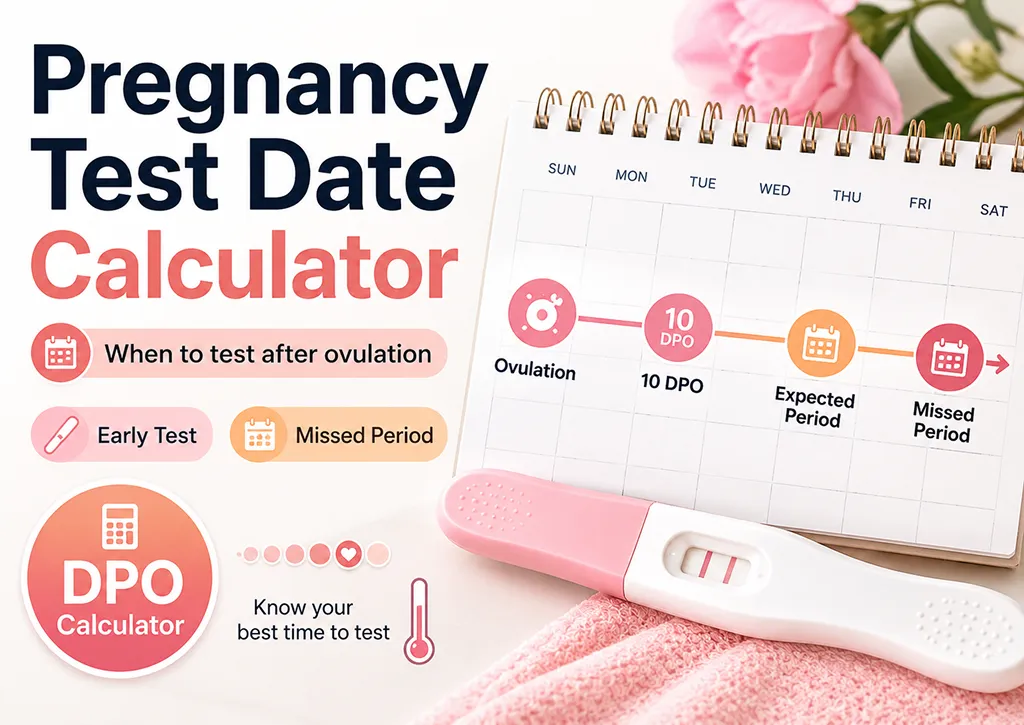
The calculator shows the date for 10 DPO, your estimated period due date, the first missed period date, and a suggested retest date. This makes it easier to separate “I want to test early” from “I want the most reliable timing.”
What does DPO mean?
DPO means days past ovulation. Ovulation day is counted as 0 DPO. The next day is 1 DPO, two days after ovulation is 2 DPO, and so on.
DPO is useful because early pregnancy testing is closely related to the time after ovulation, implantation, and hCG buildup. A test taken too early may be negative even if pregnancy is developing, because there may not be enough hCG in urine yet.
When to take a pregnancy test after ovulation
Many people start testing around 10 DPO with an early-result pregnancy test. This can be exciting, but it is still early. If the result is negative, it may simply mean that hCG has not risen enough yet, implantation happened later, or ovulation was later than expected.
A more reliable time to test is from the first day of a missed period. In this calculator, the expected period date is estimated as:
Expected period date = ovulation date + luteal phase lengthFirst missed period date = expected period date + 1 day
Why this calculator includes early test and missed period dates
Early testing and missed-period testing answer different questions. A possible early test date is for people who want to test as soon as a sensitive test might work. A missed period date is better when you want a result that is less likely to be affected by testing too early.
That is why the result separates:
- 10 DPO: possible early test date for many early-result tests
- 12 DPO: stronger early-test timing
- Expected period date: estimated period due date
- First missed period date: better timing for a more reliable home test
How the LMP mode estimates ovulation
If you do not know your ovulation date, the calculator can estimate it from your last period and average cycle length:
Estimated ovulation date = first day of last period + cycle length - luteal phase length
For example, if your last period started on March 1, your average cycle is 28 days, and your luteal phase is 14 days, the estimated ovulation date is March 15. If your cycles are irregular or you ovulate earlier or later than average, the ovulation-date mode will usually be more useful.
What if an early pregnancy test is negative?
A negative result before your missed period does not always mean you are not pregnant. Testing too early is one of the most common reasons for a false negative. If you test at 10 DPO and the result is negative, consider testing again in about 48 hours or after your missed period.
If your period is late, symptoms continue, or results are confusing, contact a healthcare provider. A blood test or clinical evaluation may be needed in some situations, especially after fertility treatment, medication that affects hCG, unusual bleeding, one-sided pain, or repeated negative tests with no period.
References used for this calculator
- NHS: most pregnancy tests can be used from the first day of a missed period.
- Mayo Clinic: home pregnancy tests are more likely to be accurate after a missed period, and hCG rises quickly in early pregnancy.
- Cleveland Clinic: pregnancy tests detect hCG, and testing too early can cause a false negative.
- Planned Parenthood: pregnancy tests detect hCG and are most accurate after a missed period.
- ASRM: luteal phase length is commonly 12 to 14 days but may range from 11 to 17 days.
- Cleveland Clinic: the luteal phase usually lasts about 14 days and ends when the menstrual period starts.