What is a Roth IRA calculator?
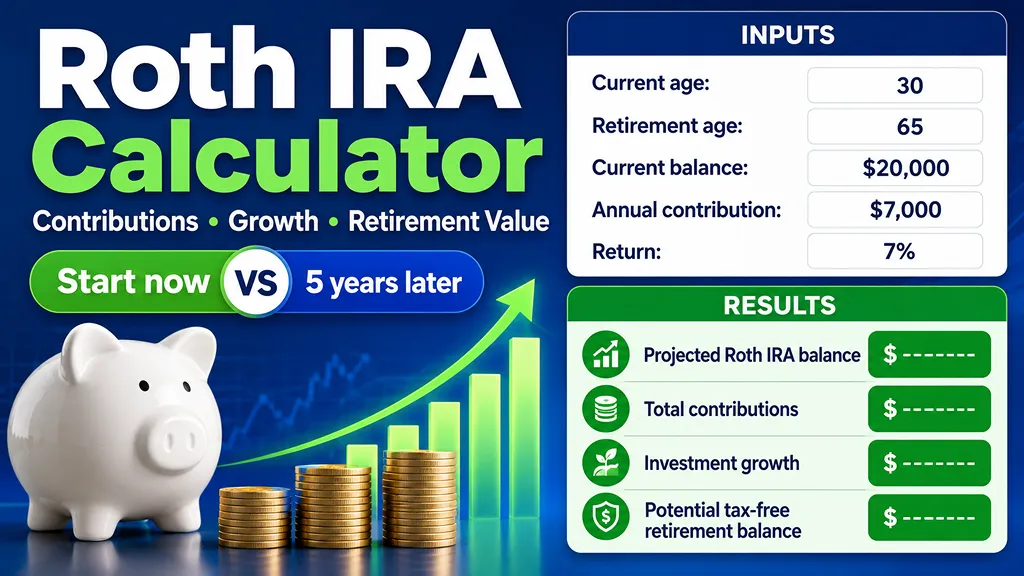
A Roth IRA calculator estimates how a current Roth IRA balance and future contributions may grow over time. This calculator uses your current age, retirement age, current balance, annual contribution, and expected annual return to estimate your retirement value, total future contributions, and investment growth.
Unlike a simple compound interest calculator, this page also compares the result of contributing now versus waiting five years. That comparison separates the gap into missed contributions and the additional investment growth that those earlier contributions could have earned.
How Roth IRA growth is calculated
The projection compounds your balance monthly. The annual contribution you enter is divided into 12 equal monthly contributions and added at the end of each month. The calculator keeps the annual contribution and annual return constant for the full projection period.
For example, if you are age 30, retire at 65, have a $20,000 balance, contribute $7,000 per year, and assume a 7% annual return, the calculator projects 35 years of monthly compounding and contributions. Actual market returns will vary from year to year, so the result is an estimate rather than a guaranteed retirement value.
Why starting five years earlier can matter
The cost of waiting is not limited to the contributions you skip. Earlier contributions also have more time to compound. That means a five-year delay can create a retirement balance gap that is larger than the amount of the missed contributions alone.
The comparison on this page keeps your existing Roth IRA balance invested in both scenarios. The only difference is when new contributions begin. This makes the comparison useful for people who already have money in a Roth IRA but are deciding whether to continue contributing now.
2026 Roth IRA contribution limits
For 2026, the IRS IRA contribution limit is $7,500. Individuals who are age 50 or older by the end of the year can generally make an additional $1,100 catch-up contribution, for a total age-based limit of $8,600. The combined limit applies across Traditional and Roth IRAs, and contributions can also be limited by taxable compensation. Roth IRA eligibility is further affected by modified adjusted gross income (MAGI) and filing status.
According to the IRS, the 2026 Roth IRA income phase-out range is $153,000 to $168,000 for single filers and heads of household, $242,000 to $252,000 for married couples filing jointly, and $0 to $10,000 for married individuals filing separately who lived with a spouse during the year.
Official references: IRS IRA contribution limits and IRS 2026 retirement plan limit announcement.
How the 2026 Roth IRA eligibility estimate works
The calculator first determines the age-based IRA limit, then estimates the Roth IRA income phase-out based on filing status and MAGI. It also checks the compensation limit and subtracts any Traditional IRA contributions you entered because Traditional and Roth IRA contributions share the same overall IRA contribution limit.
Within the Roth IRA phase-out range, the calculator estimates the reduced contribution amount using the IRS phase-out method and rounds a positive reduced amount up to the next $10, with a $200 minimum reduced contribution when applicable. This is a planning estimate; special tax situations can affect your actual eligible contribution.
What does “potential tax-free retirement balance” mean?
Roth IRA contributions are made with after-tax dollars. Qualified Roth IRA distributions can generally be tax-free, but the tax treatment of a withdrawal depends on IRS qualification rules, including the five-year rule and other distribution requirements. For that reason, this calculator labels the projected value as a potential tax-free retirement balance rather than guaranteeing that every future withdrawal will be tax-free.
Assumptions and limitations
- The annual contribution is held constant for the entire projection.
- Future IRS contribution limits and income thresholds are not automatically increased.
- The annual return is assumed to be constant and compounded monthly.
- Contributions are assumed to be spread evenly across 12 months.
- Investment fees, fund expenses, inflation, and market volatility are not modeled.
- The 2026 eligibility check is an estimate and is not tax or investment advice.
Frequently asked questions
- Q. How much can I contribute to a Roth IRA in 2026?A. The 2026 IRA contribution limit is $7,500, or $8,600 if you are age 50 or older by the end of the year. Your Roth IRA amount may be lower because of income, filing status, compensation, or Traditional IRA contributions.
- Q. Does this calculator automatically increase future IRA limits?A. No. The annual contribution you enter is held constant throughout the retirement projection. This avoids assuming future IRS inflation adjustments that are not yet known.
- Q. Why compare starting now with starting five years later?A. The comparison shows both the contributions you would miss and the compound growth those earlier contributions could have earned. It is designed to make the opportunity cost of waiting easier to see.
- Q. Is the projected Roth IRA balance guaranteed to be tax-free?A. No. Qualified Roth IRA distributions can generally be tax-free, but actual tax treatment depends on IRS distribution rules and your circumstances at the time of withdrawal.