
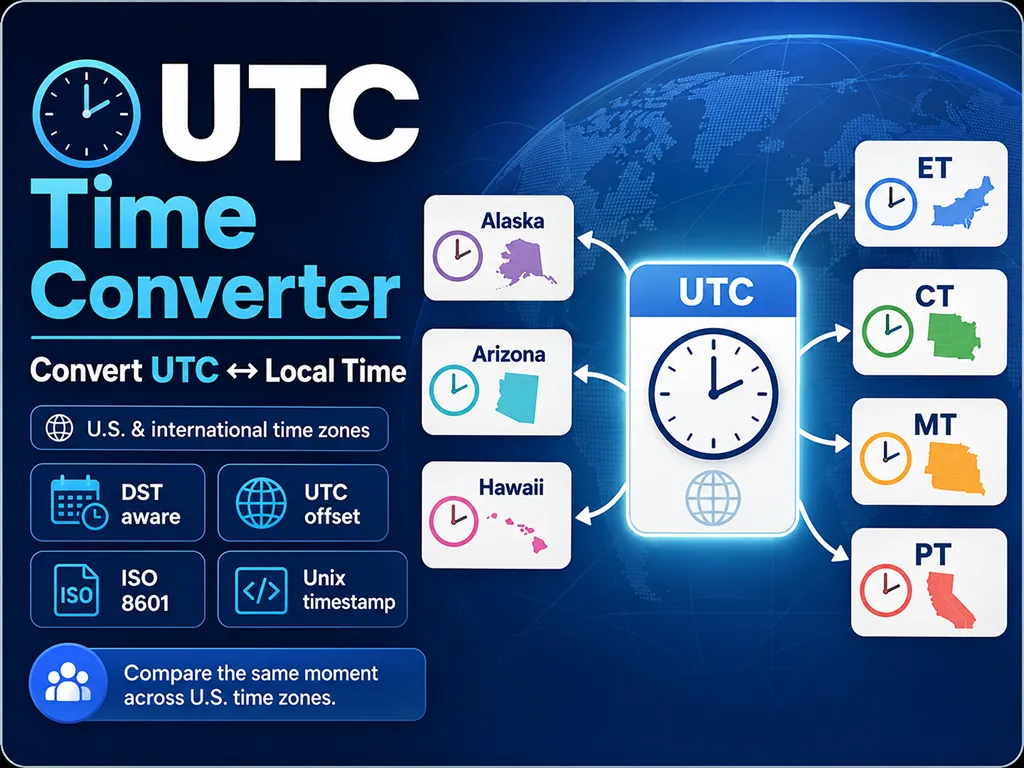
What is a UTC time converter?
A UTC time converter changes a date and time between Coordinated Universal Time (UTC) and a local time zone. UTC is the global time reference used by computer systems, aviation, scientific work, APIs, server logs, and international scheduling. Local time is expressed as an offset from UTC, such as or .
A fixed offset alone is not always enough. In many regions, the offset changes when daylight saving time (DST) starts or ends. That is why this calculator uses named time zones such as
America/New_York andAmerica/Los_Angeles instead of assuming that Eastern or Pacific Time always has the same UTC offset.How to convert UTC to local time
The basic relationship is:
is local time, is UTC, and is the UTC offset for the selected location and date.
For example, a location using is five hours behind UTC. If that location switches to during daylight saving time, the same UTC clock time converts one hour later locally. The selected date therefore matters when converting time zones.
U.S. time zones and daylight saving time
Most of the United States observes daylight saving time. Under the current federal schedule, DST begins on the second Sunday in March and ends on the first Sunday in November. When DST begins, clocks move forward one hour; when it ends, clocks move back one hour.
Important exceptions include Hawaii and most of Arizona, which do not observe DST. Because local rules and time-zone boundaries can change, using a location-based IANA time zone is more reliable than manually entering a permanent offset.
UTC vs. GMT
UTC and GMT are often shown with the same clock time, especially in everyday scheduling. However, UTC is the international time standard used for precise timekeeping, while GMT is also used as a time-zone name. For software, APIs, databases, and timestamps, UTC is normally the clearer reference.
Why time-zone abbreviations can be confusing
Abbreviations such as EST, CST, MST, and PST are convenient, but they can be ambiguous and they do not always tell you whether daylight saving time is active. For example, U.S. Eastern Time may appear as EST in standard time and EDT during daylight time. An IANA identifier such as
America/New_York carries the location-based rules needed to choose the correct offset for the date.Useful cases for a UTC converter
- Remote meetings: convert a UTC meeting time into ET, CT, MT, PT, or another participant's local time.
- Server logs: translate UTC timestamps into the local time when an event actually occurred.
- APIs and databases: verify ISO 8601 timestamps and Unix timestamps.
- Travel: compare departure, arrival, and connection times across time zones.
- Live events: publish one UTC time and provide accurate local equivalents for viewers.
What happens during DST clock changes?
When clocks move forward, some local wall-clock times never occur. For example, a region may jump directly from 1:59:59 AM to 3:00:00 AM. This calculator rejects a source time that falls inside that missing interval.
When clocks move backward, some local times occur twice. If you enter one of those repeated times, the result includes a warning because the wall-clock time alone does not uniquely identify the intended instant.
Frequently asked questions
- Q. Does UTC observe daylight saving time?
A. No. UTC itself does not move forward or backward for DST. The offset between UTC and a local time zone may change when that region changes its clocks. - Q. What is Eastern Time in UTC?
A. U.S. Eastern Time is generally during standard time and during daylight saving time. Use the date-aware converter instead of assuming one fixed offset. - Q. What is Pacific Time in UTC?
A. U.S. Pacific Time is generally during standard time and during daylight saving time. - Q. Why did my converted date change?
A. A large time-zone difference can move the converted time to the previous or next calendar day. The result shows this as “Previous day,” “Same calendar day,” or “Next day.” - Q. Can I convert local time back to UTC?
A. Yes. Choose your local region as the source time zone and select UTC as the destination.