
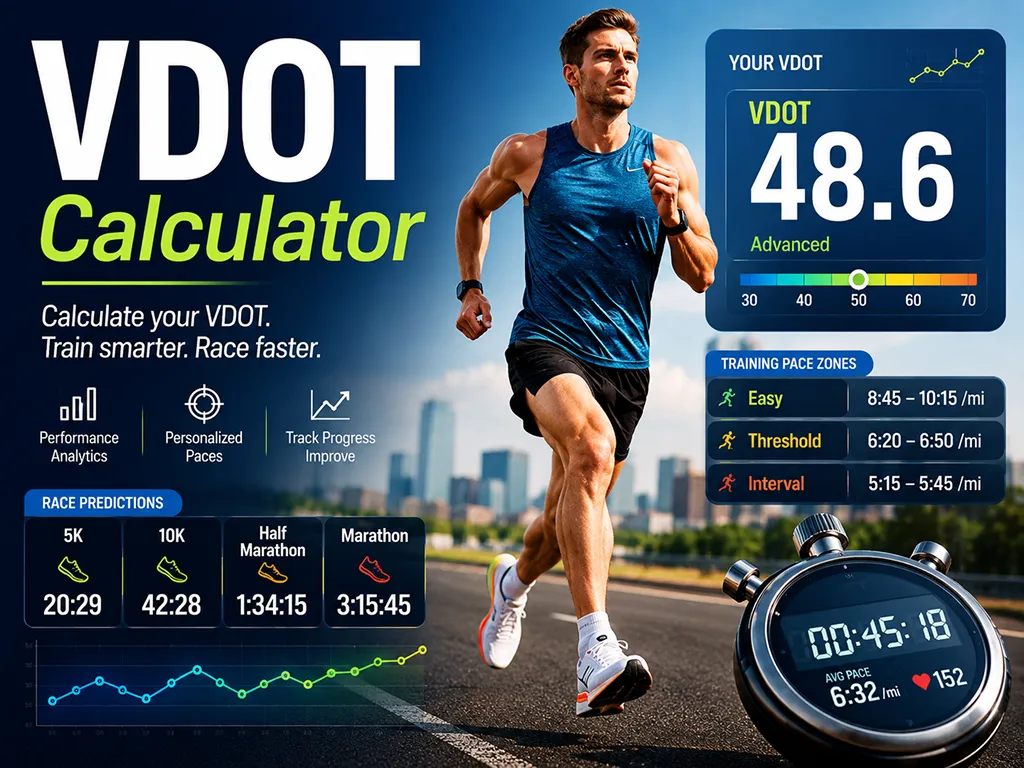
What is VDOT?
VDOT is a running fitness number popularized by coach and exercise physiologist Jack Daniels. It estimates how strong your current running performance is based on a recent race result, such as a 5K, 10K, half marathon, marathon, or mile time trial.
Unlike a simple pace calculator, VDOT looks at both race distance and race time. The result can help runners compare performances across different race distances, choose realistic goal times, and set training paces for easy runs, tempo runs, intervals, and marathon-specific workouts.
VDOT Calculator
This VDOT Calculator estimates your VDOT from a recent running performance and shows practical training information in one place. After entering your race distance and finish time, you can check your estimated VDOT, average pace, equivalent race predictions, and recommended training pace ranges.
For runners in the United States, pace is shown in minutes per mile first, with minutes per kilometer included for comparison. This makes the calculator useful for road races, track workouts, marathon training plans, and international race results.
How to use the VDOT Calculator
- Select a recent race distance, such as 1 mile, 5K, 10K, half marathon, or marathon.
- Enter your finish time in hours, minutes, and seconds.
- Use the result to review your estimated VDOT, race-equivalent times, and training paces.
- Recalculate after a new race or time trial to track changes in your running fitness.
For the most useful result, enter a recent all-out race or time trial from normal conditions. A very hot, windy, hilly, crowded, or poorly paced race can make the result less representative of your current fitness.
VDOT formula used in this calculator
This calculator uses the commonly used Jack Daniels VDOT equation structure. First, it converts your race result into running velocity, then estimates the oxygen cost of that pace and adjusts it by the fraction of maximum effort that can be sustained for the race duration.
velocity = distance in meters ÷ time in minutesoxygen cost = -4.6 + 0.182258 × velocity + 0.000104 × velocity²percent max = 0.8 + 0.1894393e^(-0.012778t) + 0.2989558e^(-0.1932605t)VDOT = oxygen cost ÷ percent max
In the formula,
t is the race time in minutes. The result is not the same as a laboratory-tested VO₂max value. It is a practical running-performance estimate based on how fast you actually raced.Best race distances to enter
A 5K or 10K result is often a good input because it is long enough to reflect aerobic fitness but short enough that fueling and long-race endurance are less likely to dominate the result. A recent half marathon or marathon can also be useful, especially if you are training for longer races.
A short race, such as a mile, may reflect speed and running economy more strongly. A marathon result may reflect endurance, fueling, pacing, weather, and course profile more strongly. For that reason, it can be helpful to compare VDOT results from more than one race distance.
How to interpret your VDOT result
A higher VDOT generally means a stronger running performance for the distance and time entered. However, the number is most useful when compared with your own previous results. For example, moving from VDOT 42 to VDOT 45 over a training cycle usually shows meaningful improvement, even if your exact race prediction depends on the course and conditions.
VDOT should be treated as a training guide, not a fixed label. Sleep, heat, humidity, altitude, hills, fatigue, and injury history can all affect how a pace feels on a given day.
How to use VDOT training paces
- Easy pace: use for recovery runs, base mileage, warmups, and cooldowns.
- Marathon pace: use for steady long-run segments and marathon-specific workouts.
- Threshold pace: use for tempo runs and cruise intervals.
- Interval pace: use for hard repeats designed to improve aerobic power.
- Repetition pace: use for short, fast repetitions with enough recovery to keep good form.
One common mistake is running easy days too fast. If your easy pace feels harder than conversational effort, slow down. VDOT paces are most helpful when they support the purpose of each workout rather than becoming a pace you force every day.
VDOT vs. VO₂max
VDOT is related to VO₂max, but they are not exactly the same. VO₂max is usually measured in a lab and describes maximal oxygen uptake. VDOT is estimated from race performance, so it includes more than oxygen capacity. Running economy, endurance, pacing skill, course difficulty, and race execution can all affect the result.
This is why two runners with the same lab VO₂max may not run the same race time, and two runners with the same VDOT may still have different strengths. One runner may be better at short races, while another may perform better in the half marathon or marathon.
Why equivalent race predictions are only estimates
The equivalent race table estimates what other race distances might look like if your current VDOT carried over cleanly. In real running, this does not always happen. A strong 5K performance does not automatically convert into a strong marathon without enough long runs, fueling practice, and endurance-specific training.
Use race predictions as planning targets, not guarantees. They are most useful for setting reasonable goals, comparing possible race distances, and checking whether a goal pace matches your current fitness.
When should you update your VDOT?
You can update your VDOT after a new race, time trial, or fitness test. Many runners recalculate after a training block, after a tune-up race, or before choosing goal paces for a new race plan. If your training has changed significantly, an older VDOT result may no longer represent your current fitness.
VDOT Calculator FAQ
- Q. Is VDOT the same as VO₂max?A. No. VDOT is a performance-based estimate, while VO₂max is usually measured directly in a lab. VDOT is often more practical for training because it comes from an actual race result.
- Q. Which race distance gives the most accurate VDOT?A. A recent, well-paced 5K or 10K is often a good choice. Longer races can also work well, but marathon results are more affected by fueling, endurance, weather, and pacing.
- Q. Should I use VDOT paces exactly?A. No. Use them as starting points. Adjust your pace for heat, hills, wind, fatigue, altitude, and workout purpose. Easy runs should still feel easy.
- Q. Why are my predicted race times different from my real results?A. Equivalent race predictions assume your fitness transfers evenly across distances. In reality, every runner has different strengths, and race conditions can change the result.
- Q. Can beginners use a VDOT Calculator?A. Yes. Beginners can use it to choose safer training paces and track progress. However, new runners should focus on consistency, easy effort, and injury prevention before doing frequent hard workouts.
Limitations
This calculator provides an estimate for training and planning. It does not replace a coach, medical advice, lab testing, or individualized training assessment. Do not use a single race result to make aggressive training changes if you are injured, returning from a break, or new to structured running.