Use your browser microphone to estimate the surrounding sound level in real time. The raw browser reading is dBFS, and this tool applies a device preset plus optional manual calibration to show a more familiar estimated dB / dBA-style reading.
Phone and laptop microphones are not calibrated Class/Type sound level meters. Use this for everyday reference, room checks, home office noise, loud restaurants, tools, appliances, or quick hearing-safety awareness.
Try the latest version of Chrome, Edge, Safari, or Firefox on a secure HTTPS page.
Current noise level
0 dB
Calibrate against a reference meter for a better estimate.
-120.0 dB
Very loud
Estimated dB needs calibration
Offset +0.0 dB
| Peak hold | -120.0 dB |
|---|---|
| Average (5s) | -120.0 dB |
| Raw dBFS | -120.0 dB |
| Example range | Concert, siren nearby, motorcycle, fireworks nearby |
NIOSH guide
8+ hr
recommended duration estimate
recommended duration estimate
OSHA context
8+ hr
PEL-style duration estimate
PEL-style duration estimate
Guidance
Below the common occupational caution threshold, but repeated exposure still matters.
Settings / Calibration
- Browser audio is measured as a relative digital signal. The estimated dB mode uses a preset offset and optional manual calibration, but it is not a certified OSHA, NIOSH, ANSI, or legal measurement.
Saved readings
No saved readings yet. Start measuring, then click “Save reading.”
Decibel meter for everyday noise checks
A decibel meter, also called a sound level meter or noise level meter, helps you understand how loud an environment is. In the United States, people often search for a dB meter when checking apartment noise, home office noise, HVAC noise, traffic, restaurants, lawn equipment, power tools, or concert volume. This browser-based tool is designed for quick reference: it uses your microphone, displays a live reading, keeps a peak value, calculates a short moving average, and lets you save readings with notes.
dB, dBA, dB SPL, and dBFS: what is the difference?
dB is a logarithmic unit, which means a small numerical change can represent a large change in sound energy. dB SPL refers to sound pressure level in air, while dBA applies A-weighting to better approximate how human hearing responds to different frequencies. A browser microphone, however, usually provides a digital input level closer to dBFS. dBFS means “decibels full scale,” where 0 dBFS is the maximum digital signal level before clipping. Because dBFS is relative to the device, this calculator uses calibration to turn the browser input into a more practical estimated dB reading.
U.S. noise exposure references: OSHA, NIOSH, and EPA
For workplace context, OSHA’s occupational noise rule uses a 90 dBA 8-hour time-weighted average as a permissible exposure limit, while NIOSH recommends a more protective 85 dBA 8-hour recommended exposure limit. The EPA has also identified 70 dB as a 24-hour environmental noise exposure level intended to prevent measurable hearing loss over a lifetime. These references are useful context, but they are not the same thing as a single instant reading from a phone or laptop microphone.
Common sound level examples
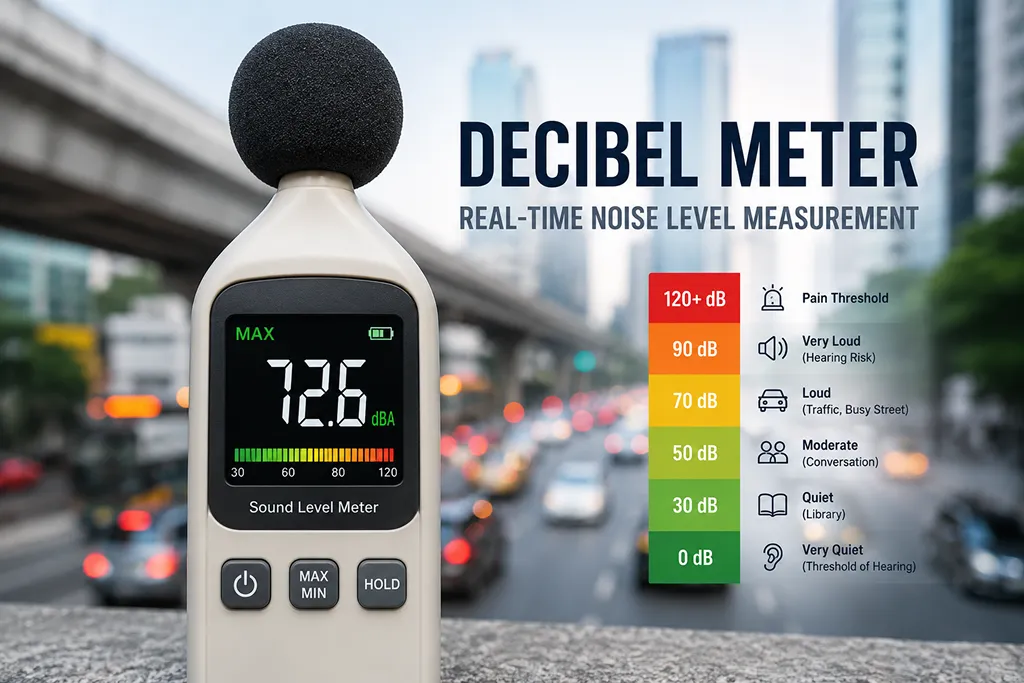
Sound levels vary by distance, room reflections, microphone position, and the exact sound source. The ranges below are approximate examples for interpreting the reading.
- 20–30 dB: quiet bedroom, very calm indoor space
- 40–50 dB: library, quiet office, refrigerator hum
- 55–65 dB: normal conversation, dishwasher, typical office
- 70–80 dB: busy street, vacuum cleaner, loud restaurant
- 85–95 dB: lawn mower, power tools, loud workshop
- 100 dB+: concert, siren nearby, motorcycle, some sporting events
How to get a better reading
- Keep the distance consistent. Sound level changes quickly as the microphone moves closer to or farther from the source.
- Avoid touching or covering the microphone. Wind, hand movement, and case friction can cause spikes.
- Use the same device when comparing rooms. Different phones and laptops can produce different results.
- Calibrate once if accuracy matters. Compare this page to a trusted sound level meter and enter the reference value.
- Use a real sound level meter for compliance. Workplace, legal, rental, construction, and engineering measurements require proper equipment and procedures.
FAQ
- Is this a real dBA meter?
It is a browser-based estimate. It does not apply certified A-weighting or meet ANSI/Type sound level meter requirements. - Why do two devices show different numbers?
Microphone sensitivity, automatic gain control, input processing, case design, and browser behavior can all affect the value. - Can I use it for OSHA compliance?
No. Use a calibrated sound level meter or dosimeter and follow the required measurement procedure for compliance work.