What Is a Title Case Converter?
A Title Case Converter is a writing tool that changes ordinary text into headline-style capitalization. It is useful when you are preparing blog titles, article headlines, YouTube titles, email subject lines, landing page headings, product names, academic paper headings, and SEO title tags.
The difficult part is that “title case” does not mean every word should be capitalized. Small words such as a, an, the, and, or, of, and to are often lowercase in the middle of a title. However, the first word, last word, and words after a colon are usually capitalized. This tool handles those common title capitalization patterns automatically.
Why This Title Case Converter Is Useful
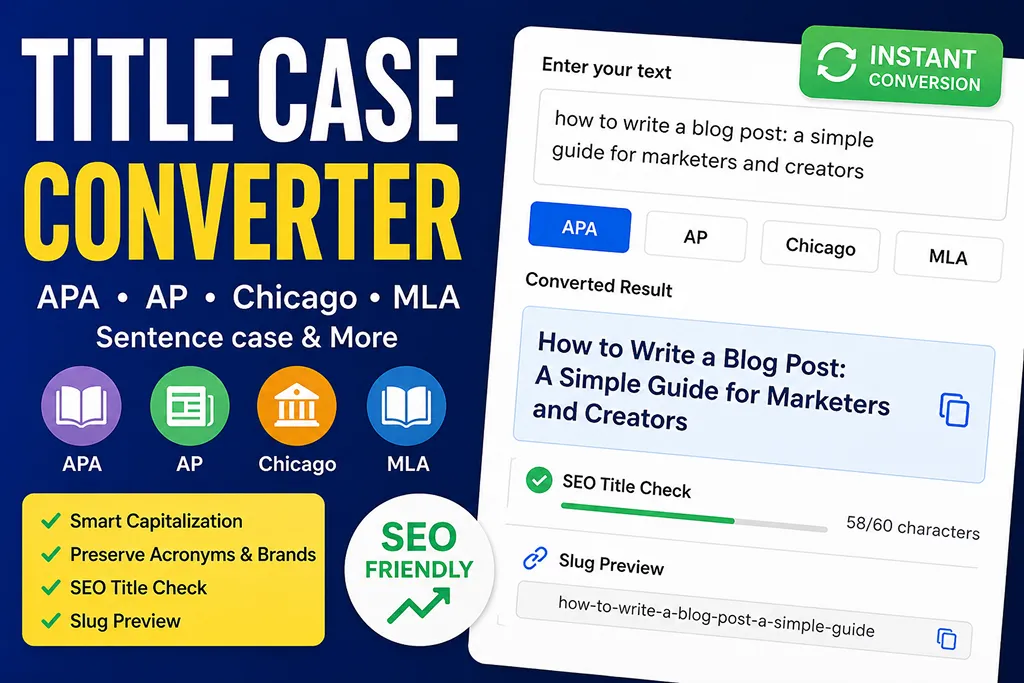
Many basic case converters only change the first letter of every word. That can create titles like “The Guide To SEO For Beginners,” even when a style guide would usually lowercase words such as “to” and “for.” This converter is designed for real publishing use: it compares multiple style guides, preserves common acronyms, keeps brand casing, and provides an SEO slug preview.
Key features
- APA, AP, Chicago, and MLA comparison: See how the same title changes under different capitalization rules.
- Sentence case and uppercase modes: Quickly convert headings for documentation, UI labels, email subjects, or social media copy.
- Acronym preservation: Keeps terms like SEO, API, URL, PDF, HTML, CSS, JSON, and SQL readable.
- Brand and tech casing: Keeps common names such as iPhone, iOS, GitHub, JavaScript, TypeScript, OpenAI, and ChatGPT.
- SEO title check: Shows character count and gives a simple readability warning when a title becomes too long.
- Slug preview: Converts the result into a clean URL-style slug that can be used for blog posts or landing pages.
Title Case vs Sentence Case
Title case capitalizes major words in a title. It is common for book titles, blog titles, headings, video titles, and article headlines. For example, “how to improve your writing” becomes “How to Improve Your Writing.”
Sentence case capitalizes the text like a normal sentence. It usually capitalizes the first word and proper nouns, while the rest stays lowercase. For example, “How to Improve Your Writing” becomes “How to improve your writing.” Sentence case is often used in product interfaces, documentation, app settings, and some editorial style systems.
APA, AP, Chicago, and MLA Title Case Differences
Title capitalization rules vary by style guide. In practical use, the biggest differences usually involve prepositions and short connecting words.
- APA title case: Capitalizes major words and generally capitalizes words of four letters or more, including many longer prepositions.
- AP title case: Often used in journalism and marketing writing. This converter applies a practical AP-style 4-letter rule for short words.
- Chicago title case: Common in publishing. It usually lowercases articles, coordinating conjunctions, and prepositions unless they are first or last.
- MLA title case: Common in humanities writing and closely aligned with headline-style capitalization for English-language titles.
Which Words Stay Lowercase in Title Case?
In the middle of a title, many style guides lowercase small connecting words. These often include articles such as a, an, and the; coordinating conjunctions such as and, but, and or; and prepositions such as of, to, in, and on. The exact result can change depending on whether you choose APA, AP, Chicago, or MLA.
When Should You Use Title Case?
Use title case when the text needs to look like a formal title or headline. It works well for blog post titles, press release headlines, report headings, book titles, podcast episode titles, landing page hero headings, and marketing campaign names. If your product or company uses a more casual interface style, sentence case may feel more natural.
SEO Tips for Title Case
Title case can make a search result or blog headline look more polished, but capitalization alone does not make a title better. For SEO, the title should still be clear, specific, and easy to scan. Put the main keyword near the beginning, avoid unnecessary filler words, and keep the final title concise enough to read comfortably in search results.
FAQ
- Q. Does title case capitalize every word?A. No. Most title case styles lowercase some short words in the middle of a title, such as articles, short conjunctions, and prepositions.
- Q. Should I use APA, AP, Chicago, or MLA?A. Use APA for many academic and social science contexts, AP for journalism or marketing copy, Chicago for publishing and editorial work, and MLA for humanities-related writing. For general web content, choose the style that matches your brand guidelines.
- Q. Why do different styles produce different results?A. Style guides define small words differently. For example, one style may capitalize a longer preposition while another keeps all prepositions lowercase in the middle of a title.
- Q. Can I use the result as an SEO title?A. Yes. The converter shows character count and a simple length warning, but you should still review the final title for search intent, clarity, and click appeal.
- Q. Does the converter detect proper nouns perfectly?A. No automatic converter can perfectly know every name, brand, or official title. This tool preserves common acronyms and brand casing, but rare names should still be reviewed.