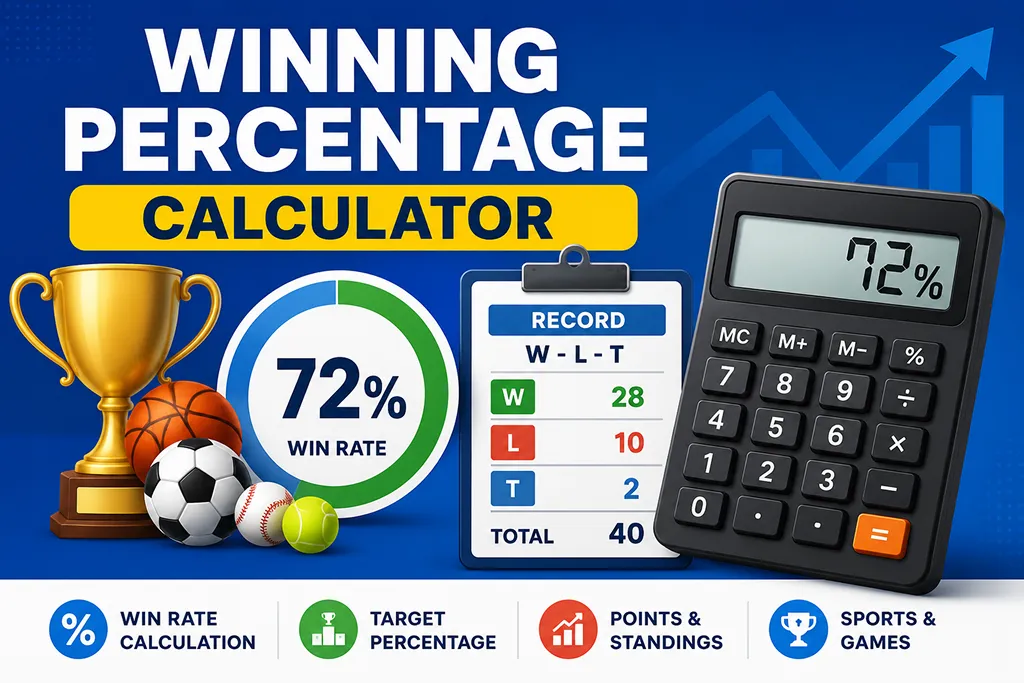
Enter your wins and losses to calculate your winning percentage, win rate, and the minimum win streak needed to reach a target winning percentage. If your sport or league uses ties, switch to the W-L-T record mode to calculate tie rate, loss rate, standings points, and points per game.
What is winning percentage?
Winning percentage is the percentage of games, matches, or rounds that a player, team, or account has won. It is commonly used in sports, esports, ranked games, fantasy leagues, tournaments, and team standings to quickly compare performance.
A winning percentage calculator turns a win-loss record into an easy-to-read percentage. Instead of checking the math manually, you can enter wins, losses, ties, or total games and see your winning percentage, win rate, loss rate, tie rate, points, points per game, and the number of straight wins needed to reach a target winning percentage.
Winning percentage formula
The basic winning percentage formula is:
Winning percentage (%) = wins ÷ total games × 100
For example, if you have 32 wins and 18 losses, you have played 50 total games. Your winning percentage is 32 ÷ 50 × 100 = 64%.
This formula is useful when you want a simple percentage based on how many games were won out of all games played. It works well for ranked games, practice records, team records, head-to-head records, and quick performance checks.
How to calculate winning percentage from wins and losses
If your record only has wins and losses, add them together to get total games:
Total games = wins + lossesWinning percentage = wins ÷ (wins + losses) × 100
For example, a 45-30 record means 45 wins and 30 losses. The total is 75 games, so the winning percentage is 45 ÷ 75 × 100 = 60%.
W-L-T record and ties
A W-L-T record includes wins, losses, and ties. For example, a 10-5-5 record means 10 wins, 5 losses, and 5 ties. In this calculator, ties are included in total games for the main winning percentage:
Winning percentage = wins ÷ (wins + losses + ties) × 100
Using a 10-5-5 record, the total number of games is 20, so the main winning percentage is 10 ÷ 20 × 100 = 50%.
Note: Some leagues and sports may treat a tie differently, such as counting a tie as half a win for official standings. This calculator focuses on a wins-out-of-total-games percentage and also shows tie rate and ties-excluded winning percentage so you can compare the record from multiple angles.
Winning percentage including ties vs excluding ties
When a record includes ties, one percentage may not tell the whole story. For example, a 10-0-10 record and a 10-10-0 record both have 10 wins in 20 total games, but they are very different records.
That is why this calculator also shows winning percentage excluding ties:
Winning percentage excluding ties = wins ÷ (wins + losses) × 100
This view removes tied games from the calculation and focuses only on games that ended with a win or loss. It can be helpful when comparing teams or players that have a different number of ties.
Standings points calculation
In W-L-T mode, this calculator can also estimate standings points using the common 3-1-0 point system:
- Win = 3 points
- Tie = 1 point
- Loss = 0 points
For example, a 10-5-5 record gives 10 × 3 + 5 × 1 = 35 points. Points per game is calculated by dividing total standings points by total games.
This is useful when comparing teams that have played a different number of games, because a team with fewer total points may still have a better points-per-game pace.
How many wins do I need to reach a target winning percentage?
If your current record is
W wins in T total games, and your target winning percentage is p%, this calculator estimates the minimum number of straight wins needed from now.x ≥ (p × T - 100 × W) ÷ (100 - p)
The result is rounded up because you cannot win part of a game. If the formula gives 3.2, you need 4 straight wins. If your current winning percentage is already at or above the target, the number of wins needed is 0.
This target calculation assumes every future game in the streak is a win. If you lose or tie during that stretch, the number of additional wins needed will change.
When to use this winning percentage calculator
- Checking a team's W-L or W-L-T record percentage
- Calculating ranked game win rate after a winning streak or losing streak
- Estimating how many wins are needed to reach a target winning percentage
- Comparing overall winning percentage with ties-excluded winning percentage
- Checking whether a standings points target is still reachable
- Comparing points per game across teams with different numbers of games played
- Tracking performance in fantasy leagues, tournaments, esports, or casual competitions
Winning percentage examples
- 20 wins, 10 losses
Winning percentage = 20 ÷ 30 × 100 = 66.67% - 12 wins, 8 losses
Winning percentage = 12 ÷ 20 × 100 = 60% - 15 wins, 10 losses, 5 ties
Main winning percentage = 15 ÷ 30 × 100 = 50%
Frequently asked questions
- Q. What does winning percentage mean?A. Winning percentage means the percentage of games or matches won out of the total games played. A 60% winning percentage means 60 out of every 100 games were wins.
- Q. Is winning percentage the same as win rate?A. In most everyday use, yes. Winning percentage and win rate both describe wins divided by total games, shown as a percentage. “Winning percentage” is especially common in sports records, while “win rate” is often used in games, esports, and analytics.
- Q. Are ties counted in winning percentage?A. It depends on the league or context. This calculator includes ties in total games for the main winning percentage and also shows a ties-excluded percentage. Some official standings may count a tie as half a win, so always check the rule used by your league.
- Q. What is a good winning percentage?A. It depends on the sport, game, league, and level of competition. In simple terms, anything above 50% means more wins than losses when ties are not considered. A much higher percentage may indicate strong performance, but strength of schedule and sample size also matter.
- Q. Why does my winning percentage change slowly after many games?A. The more games you have already played, the harder it is for one new win or loss to move the percentage. A 1-0 record changes dramatically after one game, but a 500-game record changes only slightly after one additional result.
- Q. Can winning percentage be 100%?A. Yes, but only if every game counted in the formula is a win. Once a loss or tie is included in the total-games formula, the main winning percentage cannot return to exactly 100%.