
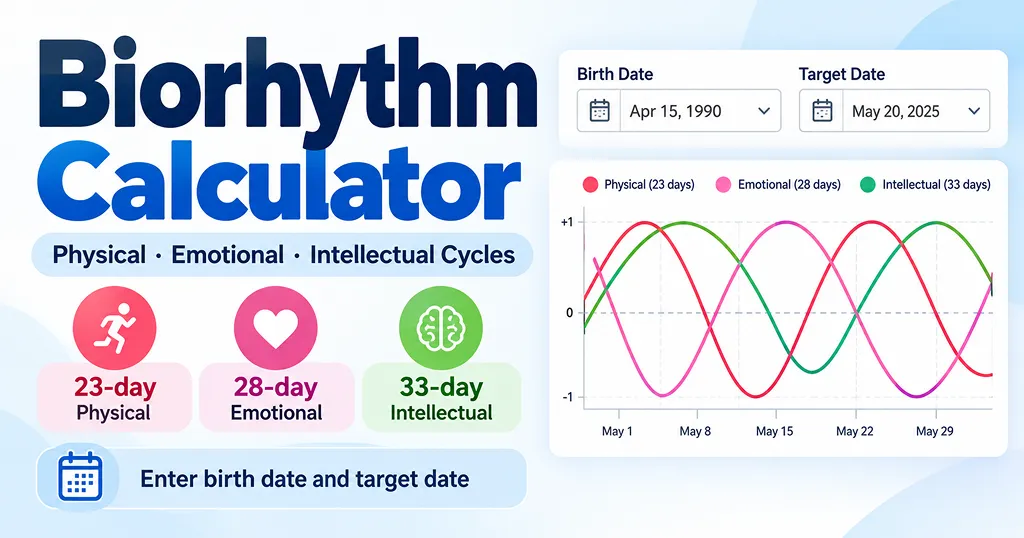
Enter your date of birth and a date you want to check to calculate the traditional physical (23-day), emotional (28-day), and intellectual (33-day)biorhythm cycles. You can also view a 60-day chart around the selected date.
What is a Biorhythm Calculator?
A biorhythm calculator uses your date of birth to plot three repeating mathematical cycles known as the physical, emotional, and intellectual biorhythms. In the traditional biorhythm model, these cycles repeat every 23 days, 28 days, and 33 days respectively.
Enter your birth date and a target date to calculate your biorhythm for today, a past date, or a future date. The calculator displays each cycle as a percentage and plots the three cycles on a biorhythm chart, making it easier to see where the physical, emotional, and intellectual waves overlap.
A value near +100% means the mathematical cycle is near the top of its sine wave, while a value near -100% means it is near the bottom. A value close to 0% indicates that the cycle is near a zero crossing. These values represent positions within the traditional biorhythm model and are not physiological measurements.
How Are Biorhythms Calculated?
A birth date biorhythm calculation starts with the number of days between your date of birth and the date you want to check. Let represent that number of days.
The traditional biorhythm formulas are:
The physical cycle completes one full wave every 23 days, the emotional cycle every 28 days, and the intellectual cycle every 33 days. Because the periods are different, the three biorhythm cycles gradually move in and out of phase with one another.
In addition to the percentage, this calculator shows the current cycle day and whether each cycle is rising or falling. The 60-day biorhythm chart lets you compare the cycles around your selected date rather than looking at a single day's values alone.
What Do the Physical, Emotional, and Intellectual Biorhythms Mean?
The traditional biorhythm theory divides the chart into three separate cycles:
- Physical biorhythm — 23 days: represents the physical cycle in the traditional model.
- Emotional biorhythm — 28 days: represents the emotional cycle in the traditional model.
- Intellectual biorhythm — 33 days: represents the intellectual cycle in the traditional model.
The calculator does not directly measure physical strength, mood, intelligence, concentration, or any other biological condition. It simply calculates the mathematical position of the three traditional sine-wave cycles from your birth date.
How to Read a Biorhythm Chart
A biorhythm chart normally ranges from -100% to +100%. Each line moves continuously through positive values, zero, negative values, and back toward positive values as its cycle repeats.
- Positive values: the cycle is in the positive half of its sine wave.
- Negative values: the cycle is in the negative half of its sine wave.
- Near 0%: the cycle is close to crossing the center line.
- Rising: the mathematical value is moving upward.
- Falling: the mathematical value is moving downward.
What Is a Biorhythm Critical Day?
In traditional biorhythm terminology, a critical day refers to a point where one of the cycles crosses the 0% line. Older biorhythm literature sometimes attached special significance to these dates.
However, a zero crossing simply means that the mathematical sine wave is changing between its positive and negative halves. Scientific research has not established that a biorhythm critical day predicts accidents, illness, poor performance, or other real-world outcomes.
Are Biorhythms Scientifically Proven?
No. The traditional birth-date biorhythm theory has not been scientifically validated as a reliable method for predicting health, mood, intelligence, accidents, athletic performance, or other human outcomes.
A review published in Psychological Reports examined 134 studies of biorhythm theory and concluded that the available evidence did not support it. A later critical review also discusses the lack of experimental validation and an established physiological mechanism for the fixed 23-, 28-, and 33-day cycles.
For this reason, this free biorhythm calculator should be used as a mathematical visualization, entertainment tool, or personal curiosity rather than as a health, medical, psychological, or performance forecast.
Biorhythm vs. Circadian Rhythm
A popular biorhythm chart based on date of birth should not be confused with a circadian rhythm.
Circadian rhythms are biological processes that follow an approximately 24-hour cycle and are studied scientifically in fields such as chronobiology and sleep research. Sleep-wake timing is one familiar example.
The fixed 23-day physical, 28-day emotional, and 33-day intellectual cyclesused by a traditional biorhythm calculator are a separate historical theory. They are not the same as scientifically established biological clocks.
How to Use the Biorhythm Calculator
- Select your date of birth.
- Choose the target date you want to calculate.
- Select Calculate.
- Review your physical, emotional, and intellectual percentages.
- Check each cycle's current day and whether the wave is rising or falling.
- Use the 60-day biorhythm chart to compare how the three cycles change around the selected date.
Frequently Asked Questions
- Q. What information do I need to use the biorhythm calculator?A. You only need your date of birth and the target date you want to check. The calculator determines the number of days between those two dates and applies the traditional 23-, 28-, and 33-day formulas.
- Q. Does birth time matter for a biorhythm calculation?A. No. The standard popular biorhythm model uses your birth date, not your exact birth time. This calculator therefore works with calendar dates only.
- Q. Can I calculate my biorhythm for today?A. Yes. Set the target date to today to calculate today's physical, emotional, and intellectual cycle values.
- Q. Can I calculate a biorhythm for a future date?A. Yes. You can select a future target date to see the mathematical position of all three cycles on that date.
- Q. Can I calculate a biorhythm for a past date?A. Yes. Select a past target date after the entered birth date to view the calculated biorhythm values for that day.
- Q. What is a biorhythm critical day?A. In traditional biorhythm theory, a critical day is a date when one of the mathematical cycles crosses the zero line. Scientific research has not established that these dates reliably predict accidents, illness, poor decisions, or other real-world events.
- Q. What does 100% mean on a biorhythm chart?A. A value near +100% means that the calculated sine wave is near its mathematical peak. It does not mean that your physical ability, mood, or intelligence has been measured at 100%.
- Q. What does -100% mean on a biorhythm chart?A. A value near -100% represents the lower mathematical extreme of that cycle's sine wave. It is not a medical or psychological measurement.
- Q. Can I use biorhythms to plan workouts, exams, or important decisions?A. You can use the chart for entertainment or personal reflection, but biorhythm values should not replace evidence-based training data, sleep management, study planning, medical guidance, or professional advice.
- Q. Is this the same as a circadian rhythm calculator?A. No. Circadian rhythms are approximately 24-hour biological rhythms. The 23-, 28-, and 33-day cycles used here belong to the traditional birth-date biorhythm theory and are a different concept.
Research references: Hines TM, “Comprehensive review of biorhythm theory,” Psychological Reports (1998), PubMed PMID 9775660; and a 2026 narrative critical review indexed by PubMed PMID 41902722. Both discuss the traditional 23-, 28-, and 33-day biorhythm model and the lack of established scientific validation for its predictive claims.