What is a wet bulb temperature calculator?
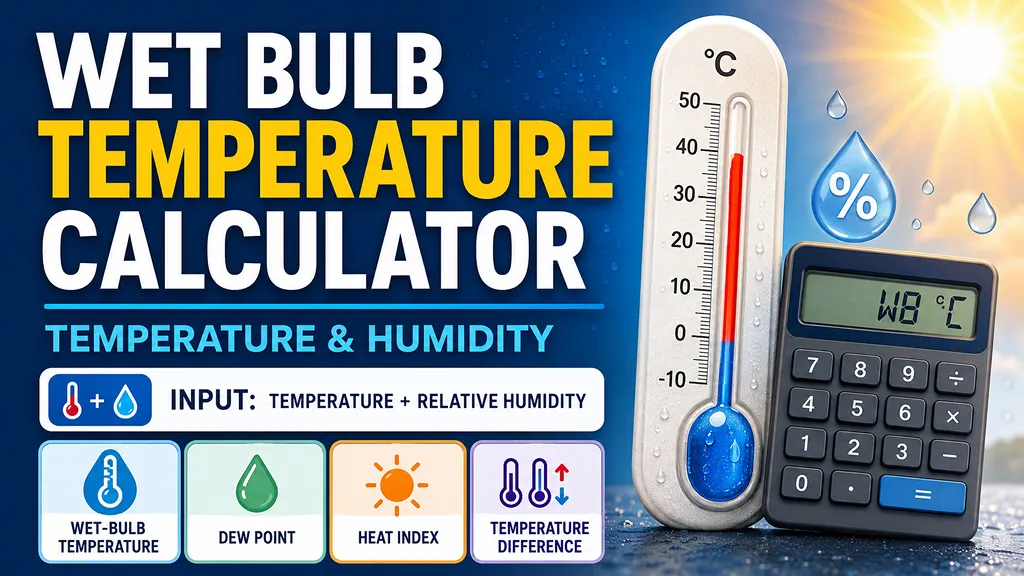
A wet bulb temperature calculator estimates the temperature a wetted, ventilated thermometer would approach as water evaporates from its surface. Because evaporation cools the wet surface, wet-bulb temperature is usually lower than the ordinary air temperature, also called the dry-bulb temperature. When relative humidity reaches 100%, evaporation can no longer provide additional cooling and the wet-bulb temperature equals the dry-bulb temperature.
How to calculate wet bulb temperature from temperature and humidity
The calculator uses the empirical approximation published by Roland Stull for wet-bulb temperature at standard sea-level pressure. The approximation takes dry-bulb temperature in Celsius and relative humidity in percent. It was designed for a practical range of about −20°C to 50°C (−4°F to 122°F) and 5% to 99% relative humidity.
The implemented wet-bulb formula is:
Here,
T is dry-bulb temperature in °C, RH is relative humidity in percent, and Tw is estimated wet-bulb temperature in °C. The calculator automatically converts Fahrenheit inputs to Celsius for the formula and converts the result back to your selected unit.What does the dry-bulb minus wet-bulb difference mean?
The difference between air temperature and wet-bulb temperature is often called the wet-bulb depression. A larger difference generally means the air is drier and evaporation has more cooling potential. A small difference means the air is already humid, so evaporation produces less cooling. At 100% relative humidity, the difference is 0°.
Wet bulb vs. dew point
Wet-bulb temperature describes evaporative cooling under ventilated wet-surface conditions. Dew point is the temperature to which air must be cooled, at roughly constant pressure and water-vapor content, for saturation to occur. Both respond to atmospheric moisture, but they answer different questions.
This page estimates dew point with a Magnus-form approximation, making it easy to compare dew point and wet-bulb temperature from the same temperature and humidity inputs. For more detailed condensation information, use the Dew Point Calculator.
Wet bulb vs. heat index
Heat index estimates how hot conditions feel to the human body when relative humidity is combined with air temperature. This calculator follows the U.S. National Weather Service procedure: a simpler estimate is used for lower apparent-temperature conditions, while the Rothfusz regression and its humidity adjustments are used when the preliminary heat index is at least about 80°F.
Wet-bulb temperature is not a “feels-like” temperature and should not be interpreted as the same measurement as heat index. If heat index is your main goal, use the Heat Index Calculator.
Wet bulb temperature is not WBGT
Wet-bulb temperature and Wet Bulb Globe Temperature (WBGT) are different measurements. WBGT is a heat-stress index that incorporates additional environmental factors and is commonly used for strenuous outdoor activity and occupational heat guidance. This calculator estimates psychrometric wet-bulb temperature from air temperature and relative humidity only; it does not calculate WBGT.
Example: 90°F and 60% humidity
With an air temperature of 90°F and relative humidity of 60%, the Stull approximation gives a wet-bulb temperature of about 78.8°F. The dry-bulb minus wet-bulb difference is therefore about 11.2°F. Enter the same values above to also compare dew point and heat index.
Limitations
This calculator is intended for general weather, HVAC, education, and planning estimates. The wet-bulb equation is an empirical approximation near standard sea-level pressure and does not explicitly include barometric pressure. Instrument wet-bulb measurements and full psychrometric calculations can differ, especially outside the stated temperature and humidity range or at substantially different elevations and pressures. Do not treat this value as a substitute for official heat warnings, WBGT measurements, workplace heat-stress procedures, or medical advice.
Frequently asked questions
- Q. Can I calculate wet bulb temperature from temperature and relative humidity?A. Yes. This calculator uses air temperature and relative humidity with the Stull approximation to estimate wet-bulb temperature near standard sea-level pressure.
- Q. Is wet bulb temperature always lower than air temperature?A. Under ordinary unsaturated conditions, wet-bulb temperature is below dry-bulb temperature because evaporation cools the wet surface. At 100% relative humidity, the two temperatures are equal.
- Q. Is wet bulb temperature the same as dew point?A. No. Wet-bulb temperature is tied to evaporative cooling, while dew point is the saturation temperature associated with the air’s water-vapor content.
- Q. Is wet bulb temperature the same as heat index or WBGT?A. No. Heat index is a feels-like temperature based mainly on air temperature and humidity. WBGT is a separate heat-stress index that accounts for additional environmental effects. Wet-bulb temperature is one distinct psychrometric quantity.