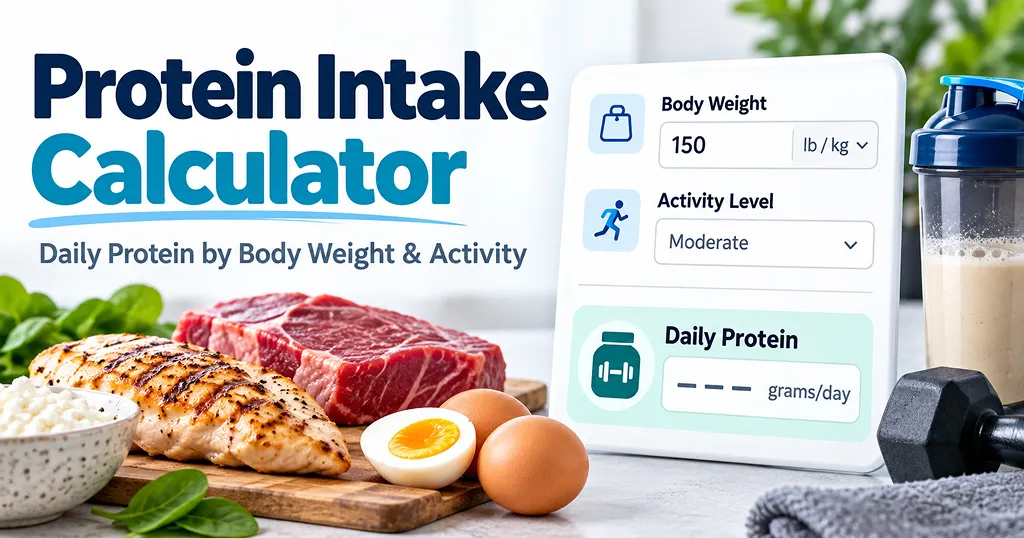
Enter your body weight and activity level to estimate a practical daily protein target. The calculator supports pounds and kilograms, shows grams per pound, and breaks your daily total into meal-sized targets.
How Much Protein Do I Need Per Day?
A protein intake calculator estimates how many grams of protein you may need each day based on your body weight and activity level. For U.S. adults, the current Dietary Guidelines for Americans, 2025–2030 provides a protein target of 1.2–1.6 grams per kilogram of body weight per day, with individual needs also depending on overall calorie needs and dietary patterns.
In pounds, that works out to approximately 0.54–0.73 grams of protein per pound of body weight. People who exercise regularly, strength train, or perform high-volume endurance training may use a higher protein range depending on their training demands and goals.
American College of Sports Medicine (ACSM) resources commonly place routinely active adults and athletes around 1.2–2.0 g/kg/day. This calculator therefore uses practical protein ranges instead of assuming that the same protein target is appropriate for everyone.
Protein Intake Calculator Formula
The calculation uses your body weight in kilograms and multiplies it by the selected daily protein target in grams per kilogram. If you enter your weight in pounds, the calculator first converts pounds to kilograms.
The calculator performs the unit conversion automatically, so U.S. users can enter body weight directly in pounds without manually converting it to kilograms.
Protein Calculator Example
For example, a person who weighs 165 lb weighs approximately 74.8 kg.
Using a protein range of 1.2–1.6 g/kg/day:
The estimated daily protein intake would therefore be approximately 90–120 grams of protein per day.
Why Do Some Protein Calculators Use 0.8 g/kg?
You may see 0.8 g/kg/day on older protein calculators and nutrition references. This number comes from the traditional adult Recommended Dietary Allowance (RDA) used in Dietary Reference Intakes.
The current Dietary Guidelines for Americans, 2025–2030, however, presents a protein target of 1.2–1.6 g/kg/day. For that reason, this calculator uses the newer Dietary Guidelines range for its general-adult setting and provides separate ranges for people with higher training demands.
The RDA and the newer Dietary Guidelines target are not necessarily describing exactly the same nutrition concept. The RDA remains an established nutrient reference value, while the calculator uses the newer Dietary Guidelines protein target as its general planning range.
Protein Per Pound: Quick Reference
If you track your weight in pounds, the following table shows several commonly used grams-per-kilogram protein targets converted to grams per pound.
Values are rounded for quick reference. The calculator uses kilograms internally for the protein calculation.
How Much Protein Is in Common Foods?
Once you know your estimated daily protein intake, you can compare that target with common protein-rich foods such as meat, poultry, fish, eggs, dairy products, beans, lentils, and other protein foods.
The amounts below are approximate. Actual protein content can vary depending on serving size, brand, cut, preparation method, and product formulation.
Food values are intended for general meal-planning reference and should not replace the Nutrition Facts label for a specific product.
How to Use Your Daily Protein Result
Treat your result as a daily protein planning range rather than a number that must be matched exactly every day. You can compare your target with Nutrition Facts labels, meal-prep portions, or a food-tracking app.
The calculator can also divide your protein target across several meals. For example, dividing a daily target across 3, 4, or 5 eating occasionscan make the result easier to use when planning breakfast, lunch, dinner, and snacks.
Dividing the total evenly is only a planning aid. Your actual protein intake does not have to be identical at every meal.
What Can Affect Your Protein Needs?
Daily protein needs can differ even between two people who weigh the same. Factors that may influence an appropriate protein intake include:
- Body weight — most protein targets are expressed relative to body weight.
- Activity level — regular exercise can increase protein needs compared with a less active lifestyle.
- Strength training — resistance training and muscle-building goals may justify using a higher sports-nutrition range.
- Endurance training — running, cycling, and other high-volume training can also affect protein requirements.
- Age and health status — individual nutrition requirements can differ based on age, medical conditions, and clinician-directed diets.
- Total calorie intake — overall energy intake and dietary pattern can affect how a protein target should be interpreted.
Frequently Asked Questions About Protein Intake
- Q. How much protein do I need per day?A. Your protein needs depend on body weight, activity level, training volume, age, overall diet, and individual circumstances. The current U.S. Dietary Guidelines provides a general target of 1.2–1.6 g/kg/day, while active adults and athletes may use higher sports-nutrition ranges.
- Q. How much protein do I need based on my weight?A. Multiply your weight in kilograms by the protein target in grams per kilogram. For example, at 1.6 g/kg, a 70 kg person would calculate: grams of protein per day.
- Q. Is this protein calculator for pounds?A. Yes. Pounds are available for U.S. users. The calculator automatically converts pounds to kilograms before applying the protein-per-kilogram formula.
- Q. How do I calculate grams of protein per pound?A. A target of 1.2 g/kg is approximately 0.54 g/lb, while 1.6 g/kg is approximately 0.73 g/lb. You can use the quick-reference table above or enter your weight directly into the calculator.
- Q. Can I use this protein calculator for muscle gain?A. Yes. Choose the strength-training or muscle-gain option. The calculator then uses an exercise-focused protein range rather than the general-adult range.
- Q. Is this also a protein calculator for weight loss?A. The calculator can be used as a protein-planning reference while managing body weight, but it does not calculate a calorie deficit or predict weight loss. Total calorie intake and the rest of your diet still matter.
- Q. Do I need to eat the exact same amount of protein every day?A. No. This protein calculator intentionally provides a range. Daily intake naturally varies, so the result is more useful as a planning target than as an exact number that must be reached every day.
- Q. Should I divide my protein evenly between meals?A. You do not have to divide protein perfectly evenly. The meal breakdown shown by the calculator simply divides your daily target into several eating occasions to make meal planning easier.
- Q. Is more protein always better?A. No. A higher protein intake is not automatically more beneficial. Protein should be considered as part of your total diet, calorie intake, and individual health needs.
- Q. Who should talk with a doctor or dietitian before changing protein intake?A. People with kidney disease or other medical conditions, people following a clinician-directed diet, and anyone with specific medical nutrition requirements should seek individualized guidance from a qualified healthcare professional.
Protein Calculator Sources and Notes
- Dietary Guidelines for Americans, 2025–2030Published by the U.S. Department of Health and Human Services and the U.S. Department of Agriculture. View the current Dietary Guidelines.
- American College of Sports Medicine (ACSM)Sports-nutrition references are used for exercise and athlete protein ranges. Visit ACSM.
- Food protein valuesFood serving examples are based on U.S. dietary guidance and are approximate. Protein content can differ by product and preparation method.
This protein intake calculator is intended for general adult education and meal planning. It does not provide a diagnosis, treatment recommendation, or personalized medical nutrition prescription.
More Health calculators & tools