What is skeletal muscle mass?
Skeletal muscle mass (SMM) is the amount of skeletal muscle in your body. Skeletal muscles attach to your bones and help produce voluntary movements such as walking, running, lifting, exercising, and maintaining posture.
Unlike body weight alone, skeletal muscle mass focuses specifically on the muscles involved in movement. It is also different from lean body mass, which includes skeletal muscle as well as bones, organs, body water, connective tissue, and other non-fat tissues.
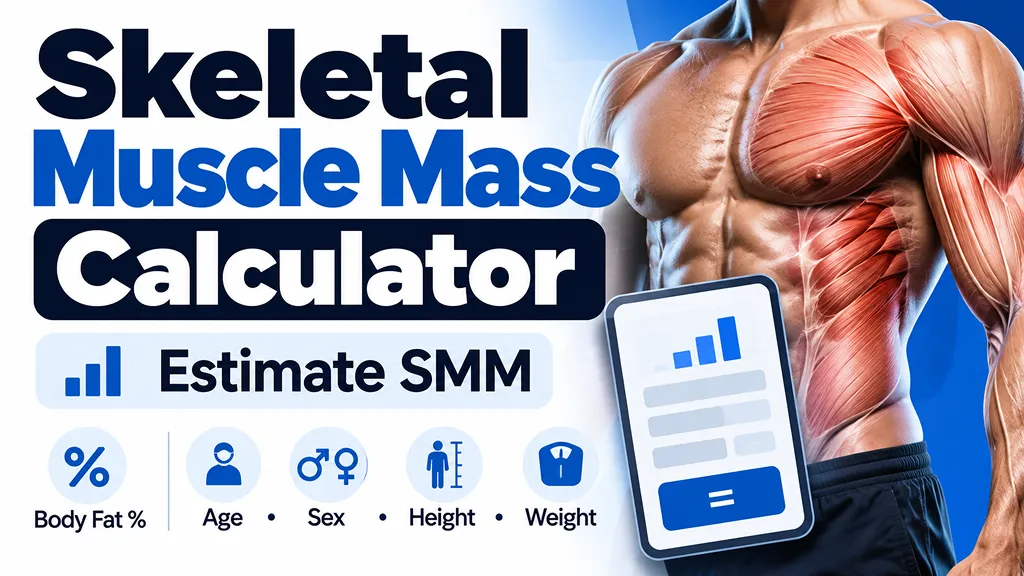
This Skeletal Muscle Mass Calculator estimates SMM using either age, sex, height, and weight or a simplified method based on body fat percentage. Results are shown in both pounds and kilograms so the calculator can be used with U.S. or metric measurements.
How does the Skeletal Muscle Mass Calculator work?
The calculator provides two ways to estimate skeletal muscle mass. If you know your age, sex, height, and weight, you can use the anthropometric equation. If you know your body fat percentage, you can instead use the body-fat-based estimate.
Age, sex, height, and weight method
The primary calculation is based on an anthropometric skeletal muscle mass prediction equation developed by Lee and colleagues. The equation estimates total-body skeletal muscle mass using basic body measurements.
The formula used by this calculator is:
In the equation, sex = 1 for male and sex = 0 for female. Weight is converted to kilograms and height is converted to meters before the formula is applied, even when you enter U.S. units.
The original published Lee model also includes a race adjustment term. This calculator does not request race and uses a reference adjustment of 0. The result should therefore be considered an estimate rather than an individualized clinical measurement.
Body fat percentage method
If you know your body fat percentage, the calculator first estimates lean body mass from your body weight and body fat percentage.
The calculator then estimates skeletal muscle mass as 55% of the estimated lean body mass.
The body-fat method is a simplified estimate intended as a rough reference. Lean body mass contains more than skeletal muscle, so this method should not be interpreted as a direct measurement of skeletal muscle tissue.
How to use the Skeletal Muscle Mass Calculator
Start by choosing between US units and Metric units. U.S. units let you enter body weight in pounds and height in feet and inches, while metric units use kilograms and centimeters.
Next, choose the calculation method:
- Age / Height / Weight: Enter your sex, age, height, and body weight.
- Body Fat %: Enter your body weight and estimated or measured body fat percentage.
Select Calculate to see your estimated skeletal muscle mass, SMM as a percentage of body weight, and equivalent result in both pounds and kilograms.
Skeletal muscle mass vs. lean body mass
Skeletal muscle mass and lean body mass are related, but they do not mean the same thing.
Skeletal muscle mass refers specifically to skeletal muscles attached to the skeleton and involved in voluntary movement. Lean body mass generally refers to body weight excluding stored body fat.
Lean body mass therefore includes skeletal muscle plus other non-fat tissues such as organs, bones, connective tissue, and body water. For this reason, lean body mass will normally be higher than skeletal muscle mass.
What is skeletal muscle mass percentage?
Skeletal muscle mass can be displayed as an absolute amount in pounds or kilograms, but comparing absolute muscle mass between people can be difficult because body size and total body weight vary.
This calculator therefore also displays your estimated skeletal muscle mass percentage, which represents estimated SMM relative to total body weight.
For example, if estimated skeletal muscle mass is 70 lb and total body weight is 175 lb, the estimated skeletal muscle mass percentage is 40%.
Skeletal muscle mass in pounds vs. kilograms
In the United States, body weight is commonly entered in pounds, while many skeletal muscle mass equations are calculated using kilograms and meters. This calculator automatically converts U.S. measurements before applying the formula.
Your result is displayed in both lb and kg, so you do not need to manually convert your skeletal muscle mass result.
How accurate is a skeletal muscle mass calculator?
A skeletal muscle mass calculator provides an estimated muscle mass. Anthropometric equations use body measurements and population data to predict skeletal muscle mass rather than measuring your muscles directly.
The Lee anthropometric model was developed and cross-validated using whole-body MRI measurements. However, an equation-based estimate can still differ from an individual's actual skeletal muscle mass.
Differences in body proportions, age, training status, body composition, and the assumptions built into the prediction model can all affect the result. For this reason, calculator results are generally more useful as a reference than as an exact measurement.
This calculator is intended for general informational purposes only. It does not diagnose sarcopenia, muscle wasting, or any other medical condition. Clinical body-composition assessment may require medical imaging or other professionally administered measurements.
What can change skeletal muscle mass?
Skeletal muscle mass differs between individuals and can change over time. Factors associated with differences in muscle mass include age, sex, body size, physical activity, resistance training, nutrition, and changes in overall body composition.
Because body weight can change from both fat and lean tissue, gaining or losing weight does not necessarily mean that skeletal muscle mass changed by the same amount.
Frequently asked questions
- Q. What does SMM stand for?A. SMM stands for Skeletal Muscle Mass. It refers to skeletal muscles attached to bones and involved in voluntary movement and posture.
- Q. How do I calculate skeletal muscle mass?A. Skeletal muscle mass can be estimated using anthropometric equations based on measurements such as age, sex, height, and weight. This calculator uses those inputs to provide an estimated SMM in pounds and kilograms.
- Q. Can I calculate muscle mass from body weight alone?A. Body weight alone cannot distinguish skeletal muscle from fat, bone, organs, and other tissues. The main calculator method also uses age, sex, and height, while the alternative method requires body fat percentage.
- Q. Can I calculate skeletal muscle mass without knowing my body fat percentage?A. Yes. Select the age, height, and weight method. You can estimate skeletal muscle mass using your sex, age, height, and body weight without entering body fat percentage.
- Q. Does the Skeletal Muscle Mass Calculator work with pounds?A. Yes. Select US (lb / ft) to enter your body weight in pounds and height in feet and inches. The calculator displays your SMM result in both pounds and kilograms.
- Q. Is skeletal muscle mass the same as muscle percentage?A. No. Skeletal muscle mass is an absolute estimate such as 70 lb or 32 kg. Skeletal muscle mass percentage expresses the estimated muscle mass as a percentage of total body weight.
- Q. Is skeletal muscle mass the same as lean body mass?A. No. Lean body mass includes skeletal muscle as well as organs, bones, connective tissue, body water, and other non-fat tissues. Skeletal muscle mass refers specifically to skeletal muscle.
- Q. What is a good skeletal muscle mass?A. There is no single skeletal muscle mass value that is ideal for everyone. Muscle mass varies with factors such as sex, age, height, body weight, body composition, and activity level. For that reason, this calculator reports your estimated SMM and its percentage of body weight rather than labeling one absolute value as normal or abnormal.
- Q. Is this the same as an InBody muscle mass result?A. No. This calculator uses prediction formulas based on the information you enter. Body-composition devices may use methods such as bioelectrical impedance and can produce different estimates. Results from different methods should not be treated as directly interchangeable.
- Q. Can I use this calculator to track muscle gain?A. You can use repeated estimates as a general reference, but small changes should be interpreted carefully because equation-based estimates are not direct measurements of muscle tissue. Using the same method and similar measurement conditions makes comparisons more consistent.
References
Lee RC, Wang Z, Heo M, Ross R, Janssen I, Heymsfield SB. Total-body skeletal muscle mass: development and cross-validation of anthropometric prediction models. American Journal of Clinical Nutrition. 2000;72(3):796-803. DOI: 10.1093/ajcn/72.3.796
Janssen I, Heymsfield SB, Wang ZM, Ross R. Skeletal muscle mass and distribution in 468 men and women aged 18–88 years. Journal of Applied Physiology. 2000;89(1):81-88. DOI: 10.1152/jappl.2000.89.1.81