Child Height Predictor Calculator: How Tall Will My Child Be?
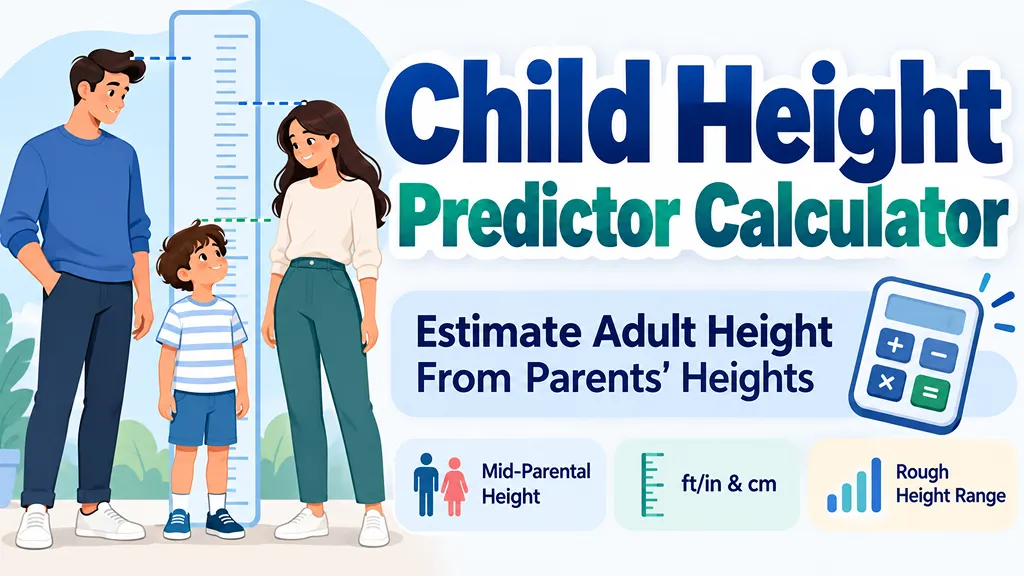
A child height predictor calculator estimates how tall a child may be as an adult based on the measured heights of both biological parents and the child's sex. This calculator uses the mid-parental height method, one of the simplest ways to estimate a child's likely adult height from family height.
If you are wondering "How tall will my child be?", the result can provide a useful reference point. However, it is not an exact prediction of final adult height. The American Academy of Pediatrics describes the mid-parental method as a rough estimate and notes that a child's growth history and bone age can provide additional information when evaluating future height.
Mid-Parental Height Formula
The mid-parental height calculator starts with the average height of both parents and then applies a sex adjustment. When using U.S. units, enter the parents' heights in inches.
For a boy:
For a girl:
The same formulas can also be written as:
Boy:
Girl:
Child Height Prediction Example
Suppose the mother is 5 ft 4 in and the father is 5 ft 10 in. First, convert both heights to inches:
Their average parental height is:
Using the mid-parental height formula, the estimated adult height would be:
- Boy: 69.5 inches, or approximately 5 ft 9.5 in
- Girl: 64.5 inches, or approximately 5 ft 4.5 in
Why Does the Height Predictor Show a Range?
A child's adult height cannot be predicted exactly from the parents' heights alone. The American Academy of Pediatrics notes that the mid-parental height estimate has a margin of error of approximately 4 inches higher or lower.
For example, if the calculated height is 5 ft 9.5 in, the calculator shows a rough range around that estimate rather than presenting 5 ft 9.5 in as a guaranteed final height. The range helps communicate the uncertainty of a child adult height prediction.
What Can Affect a Child's Adult Height?
Genetics has a major influence on adult height, which is why the heights of both parents are useful for estimating a child's future height. However, parental height is not the only factor that can influence growth.
Factors that may affect a child's growth pattern include:
- Nutrition and overall health
- Timing of puberty
- Hormonal conditions
- Chronic illnesses
- Certain medications
- Genetic conditions
Even siblings with the same biological parents can reach different adult heights. For this reason, a height predictor based on parents should be viewed as a family-height estimate rather than an exact forecast.
Mid-Parental Height vs. Bone Age
The mid-parental height method is convenient because it requires only the parents' measured heights and the child's sex. It does not require medical tests or the child's current height.
A clinical growth assessment can use additional information. A pediatrician may review serial measurements on a growth chart, calculate growth velocity, compare the child's projected height with the mid-parental height, and sometimes assess bone age using an X-ray of the hand and wrist.
These approaches answer different questions. The parental-height formula provides a quickgenetic height estimate, while growth charts and bone-age assessment can provide more information about how an individual child is actually growing.
When Should You Ask a Pediatrician About Your Child's Growth?
A height calculator cannot diagnose growth disorders. Consider discussing your child's growth with a pediatrician if you are concerned that growth is unusually fast or slow, if the child's growth pattern changes noticeably, or if puberty appears unusually early or late.
Pediatric growth evaluation may consider the child's height over time, growth velocity, family height, puberty timing, medical history, and other clinical information rather than relying on a single predicted adult-height number.
Frequently Asked Questions About Child Height Prediction
- Q. How tall will my child be?A. You cannot know a child's exact adult height in advance. The mid-parental height method can provide a rough estimate based on the heights of both biological parents and the child's sex.
- Q. Is this child height predictor accurate?A. It provides a rough family-height estimate rather than an exact prediction. The American Academy of Pediatrics notes a margin of error of about 4 inches above or below the mid-parental estimate.
- Q. How do I calculate my son's predicted adult height?A. Average the mother's and father's heights and add 2.5 inches. An equivalent formula is to add 5 inches to the combined parental heights and then divide the result by 2.
- Q. How do I calculate my daughter's predicted adult height?A. Average the mother's and father's heights and subtract 2.5 inches. An equivalent formula is to subtract 5 inches from the combined parental heights and then divide the result by 2.
- Q. Can I use centimeters instead of feet and inches?A. Yes. Select centimeters in the calculator and enter both parents' heights in cm. The calculator applies the same mid-parental height method and displays the result in both centimeters and feet/inches.
- Q. Does the child's current height affect this calculation?A. No. This simple mid-parental height formula uses the biological parents' heights and the child's sex. It does not use the child's current height. Clinical growth evaluation can additionally consider current height, previous measurements, growth velocity, puberty timing, and bone age.
- Q. Can this calculator predict a baby's exact adult height?A. No. A baby height predictor based only on parental height cannot determine exact adult height. It provides a rough genetic target that may be useful as a reference.
- Q. Is mid-parental height the same as a bone-age height prediction?A. No. Mid-parental height estimates a target height from the parents' heights. Bone-age assessment uses an X-ray of the hand and wrist together with other growth information and is part of a more detailed clinical evaluation.
References
The mid-parental height formula and approximate height range used by this calculator are based on guidance from the American Academy of Pediatrics' HealthyChildren.org. Information about growth evaluation, growth charts, mid-parental height, and bone age is also consistent with American Family Physician guidance on evaluating short and tall stature in children.
This child height predictor calculator is intended for general educational use only. Its results are estimates and are not a medical diagnosis or a substitute for evaluation by a pediatrician or other qualified health professional.