
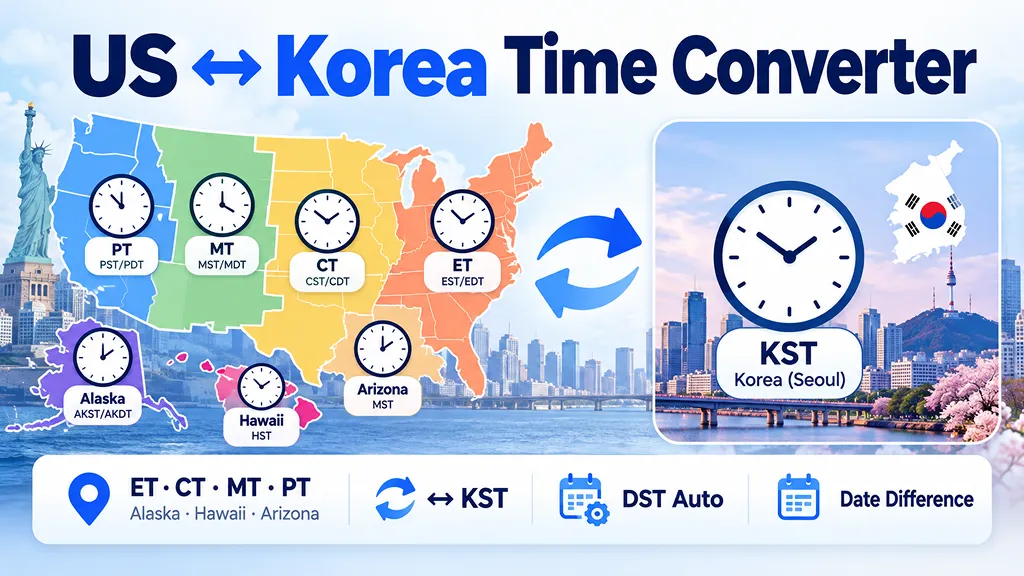
What is the US ↔ Korea Time Converter?
The US ↔ Korea Time Converter converts local time between major U.S. time zones and South Korea Standard Time (KST). It covers Eastern, Central, Mountain, Pacific, Alaska, Hawaii, and most of Arizona, with representative cities such as New York, Chicago, Denver, Los Angeles, Anchorage, Honolulu, and Phoenix.
It is designed for meetings, interviews, flights, live events, game releases, customer calls, and remote work between the United States and South Korea. Unlike a simple fixed-offset calculator, the automatic mode checks the date and applies daylight saving time when the selected U.S. city observes it.
U.S. time zones compared with Korea
How to convert U.S. time to Korea time
South Korea uses KST, which is UTC+9 year-round. To convert a U.S. local time to Korea, compare the U.S. UTC offset with UTC+9. For example, Korea is 17 hours ahead of PST (UTC−8) and 16 hours ahead of PDT (UTC−7). If adding the difference crosses midnight, the Korean calendar date changes as well.
- 9:00 AM EST in New York → 11:00 PM KST
- 9:00 AM EDT in New York → 10:00 PM KST
- 9:00 AM CDT in Chicago → 11:00 PM KST
- 9:00 AM PST in Los Angeles → 2:00 AM KST the next day
- 9:00 AM PDT in Los Angeles → 1:00 AM KST the next day
- 9:00 AM HST in Honolulu → 4:00 AM KST the next day
PST/PDT to KST
Los Angeles, San Francisco, Seattle, and much of the U.S. West Coast use Pacific Time. During standard time, PST is UTC−8 and Korea is 17 hours ahead. During daylight saving time, PDT is UTC−7 and Korea is 16 hours ahead. If an event is described as “Los Angeles time,” automatic city mode is safer than forcing PST year-round.
EST/EDT to KST
New York and Washington, D.C. use Eastern Time. EST is UTC−5, so Korea is 14 hours ahead. EDT is UTC−4, so Korea is 13 hours ahead. A typical U.S. East Coast morning often falls in the late evening in Korea.
CST/CDT and MST/MDT to KST
Central Time uses CST (UTC−6) or CDT (UTC−5), while Mountain Time uses MST (UTC−7) or MDT (UTC−6). Most of Arizona is a special case: Phoenix stays on MST and does not switch to daylight saving time, while Denver changes between MST and MDT.
Daylight saving time: skipped and repeated hours
When daylight saving time starts, clocks move forward and some local U.S. clock times never occur. When it ends, clocks move backward and one local hour occurs twice. This converter detects a skipped time and asks you to choose between the first and second occurrence when a fall-back time is ambiguous.
Under current U.S. rules, participating areas generally begin daylight saving time on the second Sunday in March and return to standard time on the first Sunday in November. Hawaii and most of Arizona do not observe DST.
When this converter is useful
- Scheduling Zoom, Google Meet, or interview times between the U.S. and Korea
- Converting U.S. sports, concerts, livestreams, and release times to KST
- Checking New York or Los Angeles flight times against Seoul time
- Planning customer support or remote-team working hours
- Converting EST, EDT, CST, CDT, MST, MDT, PST, PDT, AKST, AKDT, or HST to KST
Frequently asked questions
- Q. How many hours ahead is Korea from the U.S.?A. It depends on the U.S. time zone and daylight saving time. Korea is generally 13–14 hours ahead of Eastern Time, 14–15 hours ahead of Central, 15–16 hours ahead of Mountain, and 16–17 hours ahead of Pacific Time.
- Q. Is Korea always 17 hours ahead of California?A. No. Korea is 17 hours ahead when California is on PST and 16 hours ahead when California is on PDT.
- Q. What is the difference between EST and EDT?A. EST is Eastern Standard Time at UTC−5. EDT is Eastern Daylight Time at UTC−4. Korea is 14 hours ahead of EST and 13 hours ahead of EDT.
- Q. Why can the date change when converting to Korea?A. Korea is many hours ahead of the continental U.S., so an afternoon or evening in the U.S. can already be the next calendar day in Korea.
- Q. When should I use fixed EST, CST, MST, or PST?A. Use a fixed standard-time offset only when the source explicitly specifies that abbreviation as a fixed UTC offset. For a real city such as New York or Los Angeles, use automatic city time so DST is applied correctly.