
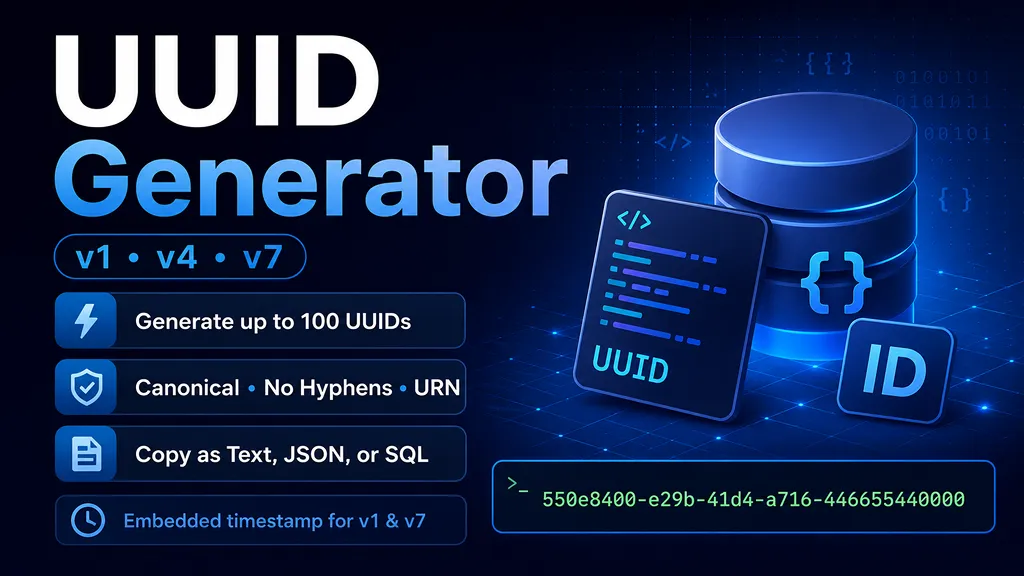
What is a UUID generator?
A UUID generator creates a 128-bit identifier that can be used to label records, objects, files, sessions, events, and other data without relying on one central counter. UUID is short for Universally Unique Identifier. The current UUID specification is RFC 9562, which defines the UUID layout, variant, and versions including UUID v1, v4, and v7.
A UUID is commonly shown as 32 hexadecimal characters separated by four hyphens, for a total of 36 visible characters. A typical UUID v4 looks like
550e8400-e29b-41d4-a716-446655440000.UUID v4 vs. UUID v7
UUID v4 is the most familiar choice for general-purpose random identifiers. Its non-version and non-variant bits are generated from random or pseudorandom data, so IDs do not carry a creation timestamp that is intended for sorting.
UUID v7 places a Unix timestamp in the high-order portion of the UUID and uses the remaining space for additional data such as randomness. This makes canonical UUID v7 values naturally useful when you want identifiers that are approximately ordered by creation time. For new database-backed applications, that ordering can also provide better key locality than fully random UUID v4 values in some storage engines and index designs.
What about UUID v1?
UUID v1 is a time-based UUID format that includes timestamp, clock-sequence, and node fields. It remains useful for compatibility with systems that explicitly require v1, but new applications often choose v4 for random IDs or v7 when time ordering is useful.
Canonical, compact, and URN UUID formats
This generator can format the same UUID in several common forms:
- Canonical: 36 characters including hyphens, such as
xxxxxxxx-xxxx-xxxx-xxxx-xxxxxxxxxxxx. - Compact: the same hexadecimal digits with the hyphens removed.
- URN: the canonical UUID prefixed with
urn:uuid:.
Are UUIDs guaranteed to be unique?
UUIDs are designed so that independently generated identifiers have an extremely low chance of collision when the version is implemented correctly, but “universally unique” is not a literal mathematical guarantee for every generated value. Applications that require hard uniqueness should still enforce a unique constraint at the database or storage layer.
Why generate UUIDs in bulk?
Bulk UUID generation is useful for fixture data, database imports, API mock responses, test accounts, migration scripts, spreadsheet IDs, and other development workflows. This page can generate up to 100 UUIDs at once, verifies uniqueness within the current batch, and lets you copy the result as newline-separated text, a JSON array, or SQL-ready quoted values. For v1 and v7, it also decodes the embedded timestamp from the first generated UUID.
UUID vs. GUID
In everyday software development, GUID and UUID usually refer to the same 128-bit identifier format. “GUID” is terminology strongly associated with Microsoft platforms, while “UUID” is the terminology used by the RFC specification.
Can I use a UUID as a password or API key?
Do not treat a UUID as a secret just because it looks random. UUIDs are identifiers, not a password format or an authentication scheme. If you need an API key, password reset token, session secret, or other credential, use a dedicated cryptographically secure token design with enough entropy and appropriate expiration, storage, and rotation rules.
Common UUID use cases
- Primary keys or public IDs for database records
- Object IDs in APIs and distributed services
- Request, trace, job, and event identifiers
- Test fixtures and mock data
- File, upload, and asset identifiers
- Offline-created IDs that can be merged later
Frequently asked questions
- Q. Which UUID version should I use?A. For a general random identifier, UUID v4 is a simple default. If you are designing a new system and want IDs that sort roughly by creation time, consider UUID v7. Use UUID v1 when you need compatibility with an existing v1-based system.
- Q. How long is a UUID?A. A UUID is 128 bits. The canonical text form uses 32 hexadecimal digits plus four hyphens, so it is 36 characters long.
- Q. Does uppercase vs. lowercase change the UUID?A. No. The hexadecimal letters can be displayed in uppercase or lowercase without changing the underlying 128-bit UUID value. Lowercase is common in modern application output.
- Q. Are the generated UUIDs sent to a server?A. This page generates UUIDs in the browser using the project's UUID library. Copying or reformatting the generated values does not require sending the UUID list to a generator API.